Zitadelle Vechta, Renaissance citadel in Vechta, Germany.
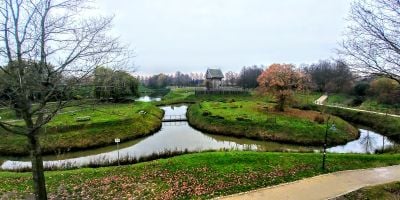
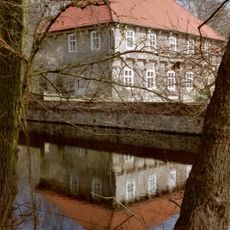
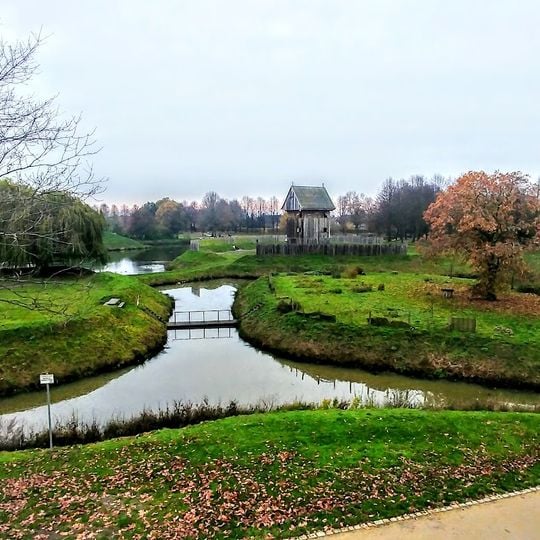
The Zitadelle Vechta is a partly reconstructed citadel park on the site of the fortress begun in 1666 and razed in 1769. Only the Zeughaus and the Kaponier survived; after excavations from 1987 to 1991, the Friedrich-Christian Bastion and half of the Maximilian Bastion were rebuilt within a 22-hectare park, bordered by moats and a 2 km avenue.
Prince-Bishop Christoph Bernhard von Galen of Münster began building the citadel, first named Sancta Maria, in 1666 and completed it in 1669. After the town fire of 8 August 1684, houses west of the main street were not rebuilt to clear a field of fire, and the castle was demolished, its tower stones reused for the casemates. The five-bastion fortification, over 30 hectares with a 700-metre diameter, was surrendered without a fight in 1758 during the Seven Years' War and razed in 1769; only the Zeughaus and the Kaponier survived.
The Zeughaus, one of the buildings inside the citadel, now houses a museum with objects and documents tied to the history of the Vechta region. Visitors can see how the space shifted from a military storehouse to a place that keeps local memory alive.
The grounds are open on most days, and sturdy footwear is a good idea since parts of the site have uneven surfaces and cobblestones. Starting with a walk around the outer walls gives a good sense of the overall scale before heading inside.
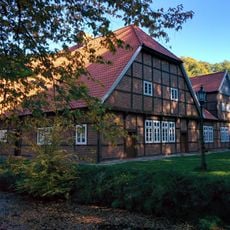
The Gulfhaus on the citadel grounds was built in 1886 by an East Frisian carpenter serving a sentence at Vechta prison. He intended to ship the wooden frame home on release, but died before finishing his term, so the building stayed and served as the institution's stable. It now houses a youth and culture centre.
The community of curious travelers
AroundUs brings together thousands of curated places, local tips, and hidden gems, enriched daily by 93,975 contributors worldwide.