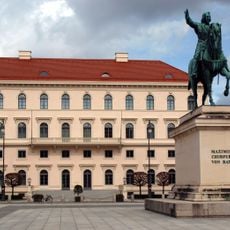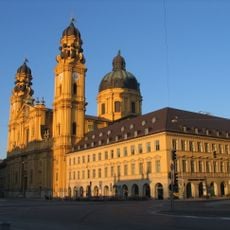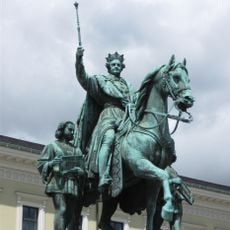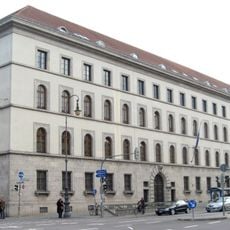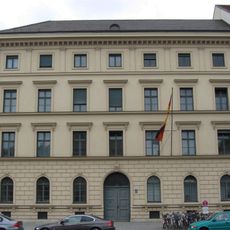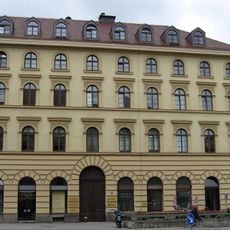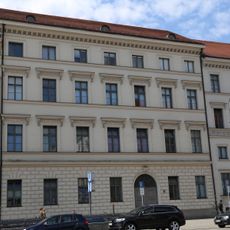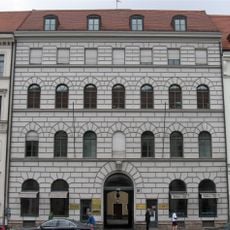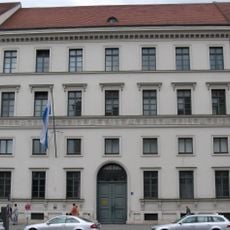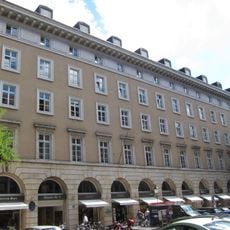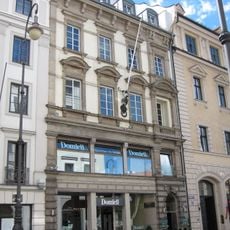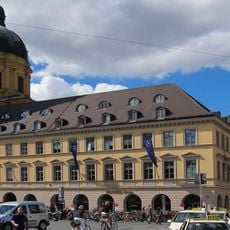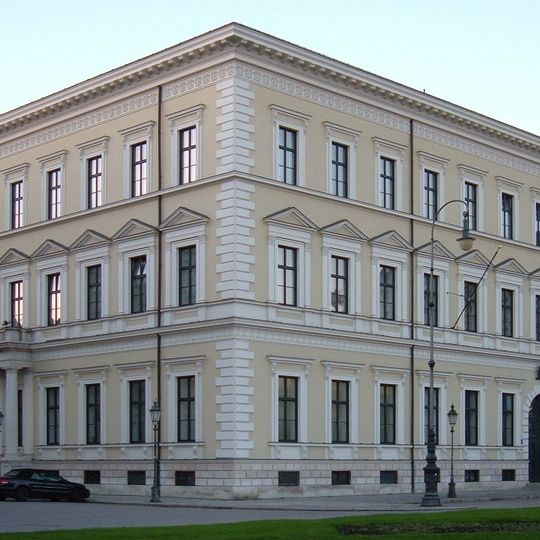
Palais Leuchtenberg, Renaissance Revival city palace in Ludwigstrasse, Munich, Germany.
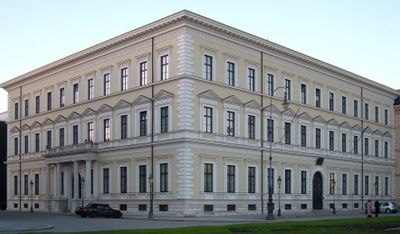
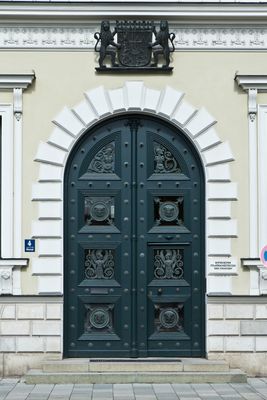
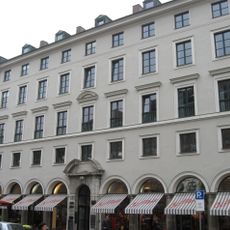
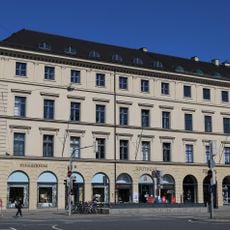
Palais Leuchtenberg is a city palace on the west side of Odeonsplatz, built 1817–1821 by Leo von Klenze in Italian neo-Renaissance style after the Palazzo Farnese in Rome. Its pale beige stucco facade has white rusticated quoins at the corner, a molded cornice, and tall rectangular windows in regular bays above a grey stone base. The arched entrance door is dark green with studs and relief panels of cherubs and lion medallions.
Eugène de Beauharnais, Napoleon's stepson and brother-in-law of the later King Ludwig I, commissioned Leo von Klenze to build the palace between 1817 and 1821. It was the first building on the Ludwigstraße and cost 770,000 guilders. After wartime damage in 1943 and 1945, the ruin was demolished in 1957; Hans Heid and Franz Simm rebuilt it in 1963–1967 with a reconstructed façade.
Klenze modelled the palace on the Palazzo Farnese in Rome, not on Florentine prototypes, and placed eagles over the first-floor windows as in one of Napoleon's palaces. The building is named after Eugène de Beauharnais, Duke of Leuchtenberg; between 1853 and 1933 it was called Luitpold Palais after Prince Luitpold, who bought it in 1852.
The palace is easily accessible by Munich's public transportation, with several bus and train stations within walking distance of the site. Its location on Ludwigstrasse makes it convenient to visit while exploring the surrounding classical quarter on foot.
The building underwent major structural alterations in 1967 that reshaped its interior layout and functional spaces while preserving its outer appearance. This balance between modernization and conservation illustrates how historic buildings can adapt to contemporary needs without losing their visual character.
The community of curious travelers
AroundUs brings together thousands of curated places, local tips, and hidden gems, enriched daily by 94,014 contributors worldwide.