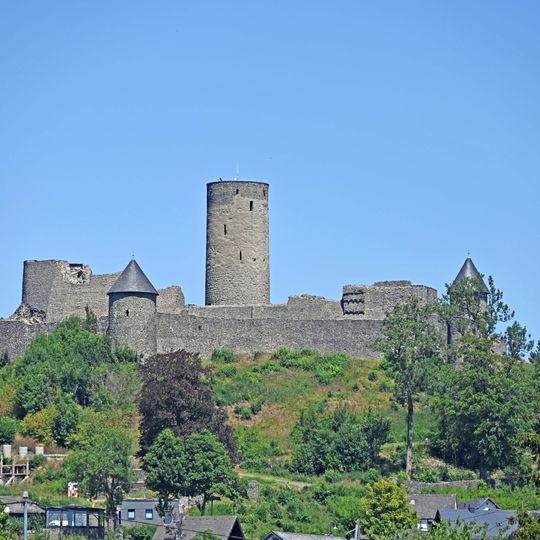
Nürburg Castle, Medieval castle ruin in Nürburg, Germany.
Nürburg Castle is a medieval fortification on a volcanic cone in the Eifel region. The structure consists of stone walls, towers, and ramparts spread across the hillside, displaying different building periods.
First recorded in 1166 as Noureberg or Mons Nore, the castle was probably preceded by a Roman signal station guarding the Eifel road. Count Ulrich, named in a 1169 document, is considered its builder, though his father Dietrich I of Are had begun a refuge castle on the summit. In 1290 it passed to the Electorate of Cologne, which installed a bailiff. Swedish troops took and plundered it in 1633; French soldiers destroyed it in 1689, after which it served as a quarry.
The name Nürburg comes from the lords of Nürburg and Are, the family of Count Ulrich, named in a 1169 document; his father Dietrich I of Are had already begun a refuge castle on the hill. The family died out, and in 1290 the castle passed to the Electorate of Cologne, which installed a bailiff. The village below still bears the castle's name.
The site sits atop a hill and is best explored from the top, as this gives you an overview of the entire structure. The paths are uneven in places and include stairs, so sturdy footwear is advisable.
The 20-metre bergfried serves as a viewing tower, and since May 2016 Hans-Peter Hoffmann has operated the ruin. In 1818 Prussia restored the keep to use it as a trigonometric point, and the outer ward was demolished during that work. In 1952 the municipality of Nürburg built a ski slope with a lift and a ski jump on the mountain's north side.
The community of curious travelers
AroundUs brings together thousands of curated places, local tips, and hidden gems, enriched daily by 92,978 contributors worldwide.