Palais Thurn und Taxis, Royal palace in Frankfurt, Germany
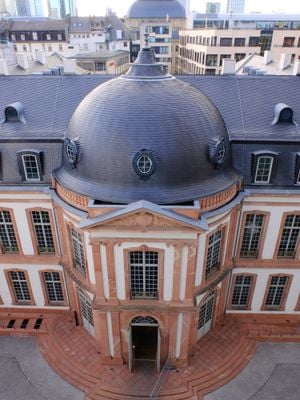
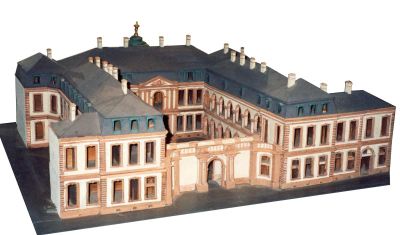
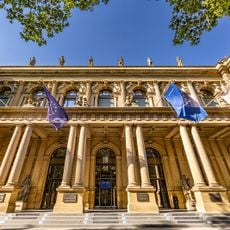
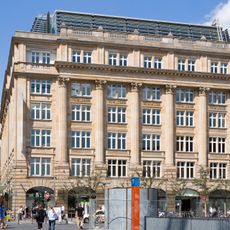
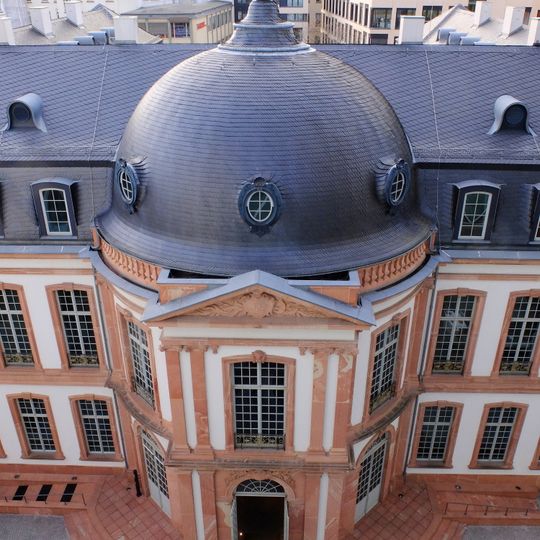
Palais Thurn und Taxis is a reconstruction of the 1731–1739 palace designed by Robert de Cotte, set in an L-shaped courtyard off the Große Eschenheimer Gasse. Its white walls carry reddish-brown stone banding and trim; the left wing has a dark grey mansard roof with three blue-framed dormer windows, and the inner corner shows an arcade of arched bays above a lower level. A round-arched entrance gate with flanking columns faces the courtyard.
The building was constructed between 1731 and 1739 to designs by French architect Robert de Cotte as the headquarters of the imperial postal service. After World War II the damaged palace was demolished in 1951, until it was rebuilt in 2004 as part of the Palais Quartier project.
The name comes from the Thurn und Taxis family, whose imperial post operated from Frankfurt since 1610; the palace served as the headquarters of that post from 1748. From 1816 to 1866 the Bundestag of the German Confederation met in the building, chaired by the Austrian envoy, with the public excluded. The interior furnishings were moved to Schloss Emmeram in Regensburg in 1895; parts acquired by Bavaria in 1993 are shown in a museum.
The palace stands in the Große Eschenheimer Gasse, not on the Zeil, and today holds offices and shops rather than an event hall. The reconstruction of 2004 to 2009 follows a changed floor plan, so the courtyard is L-shaped. Look for the round-arched entrance gate with flanking columns at the front of the courtyard.
In the 19th century the rooms of this building hosted the representatives of the German Confederation during their sessions. This function linked the postal history with the political history of the region, before the building later served as an ethnological museum.
The community of curious travelers
AroundUs brings together thousands of curated places, local tips, and hidden gems, enriched daily by 92,783 contributors worldwide.