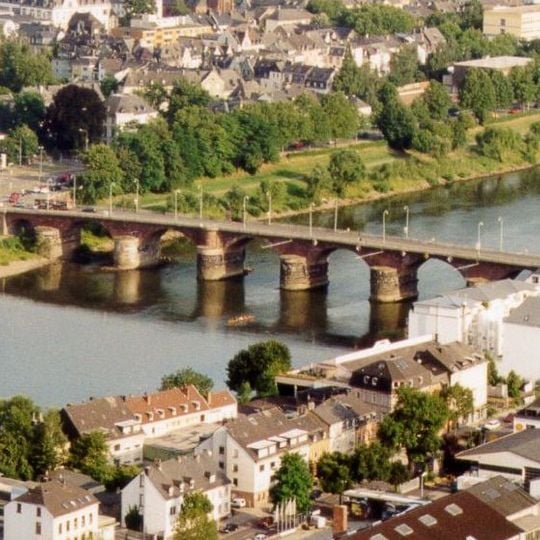
Roman Bridge, Roman bridge in Trier, Germany.
The Roman Bridge carries a flat roadway with low railings and slender posts across the Moselle on nine stone piers. The piers are broad and rounded, forming at least five visible arches, and stand on wide bases at the waterline. The stonework is light grey-brown. The two piers nearest the city are buried in the bank fill.
The current structure was built in the 2nd century, replacing two earlier wooden bridges dating back to 17 BCE. Despite damage and repairs over many centuries, the bridge has retained its original Roman form.
In Roman times, throwing a coin from the bridge into the Moselle was considered a good-luck offering; experts estimate that around a million coins may lie in the riverbed. On the fifth pillar from the west, a crucifix and a statue of Saint Nicholas of Myra were placed in 1716–1718. The medieval bridge gate, the Porta Inclyta, has not been located: scholars still debate whether it stood on the left or right bank.
Pedestrians and vehicles use the bridge daily, so it is best visited in early morning or late afternoon when traffic is lighter. Access is straightforward from either side of the city.
This is the oldest standing bridge structure in Germany and still carries daily traffic, a testament to the durability of Roman construction. This combination of great age and continuous use is extremely rare among bridges from that era.
The community of curious travelers
AroundUs brings together thousands of curated places, local tips, and hidden gems, enriched daily by 93,744 contributors worldwide.