Campen Lighthouse, Steel lighthouse in Krummhörn, Germany
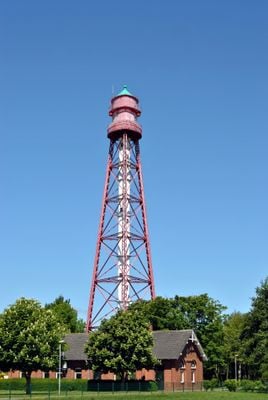
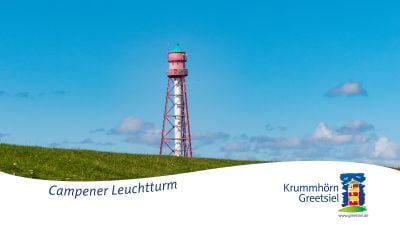
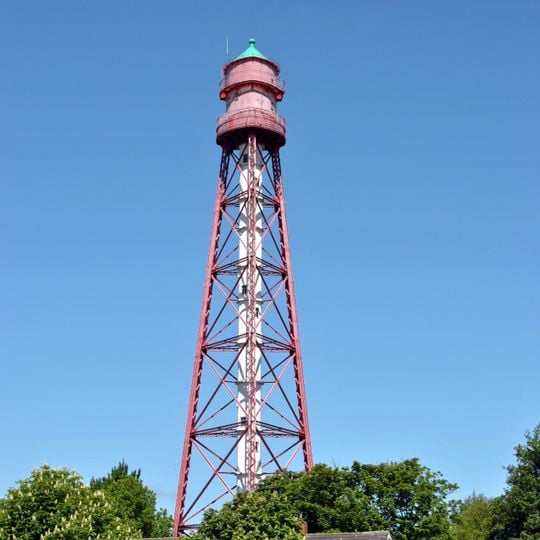
Campen Lighthouse is a free-standing steel lattice tower with a triangular cross-section, rising 65.3 metres from behind trees near the Ems estuary. Its red framework braces a central white cylinder banded in red, topped by a red gallery and lantern room with a green roof. Inside, a stair shaft runs up the middle; the tower weighs around 300 tonnes.
Campen Lighthouse was planned from 1883 as one of five guiding lights in a German-Dutch project to light the Lower Ems, with costs shared by Prussia and the Netherlands. Construction began in 1889 and was finished in 1890; the tower entered service with the other four lights on 1 October 1891. It was Germany's second electrically operated lighthouse, after the one on Borkum.
The lighthouse marks the skyline of Krummhörn and serves as a landmark that locals point to when describing their region. Visitors come regularly to enjoy the views and understand the seafaring history that shaped this coastal area.
Visitors can climb a spiral staircase with about 300 steps to reach a viewing platform with views over Krummhörn, the island of Borkum, and the surrounding North Sea landscape. The climb requires average physical fitness, and once at the top you get a full view in all directions.
Inside the lighthouse sits Germany's oldest working diesel engine, a 20-horsepower MAN model from 1906. The engine once powered electricity generation for the lighthouse and represents an early example of industrial machinery still in existence today.
The community of curious travelers
AroundUs brings together thousands of curated places, local tips, and hidden gems, enriched daily by 92,852 contributors worldwide.