Castra Novaesium, Roman military fort in Neuss, Germany.
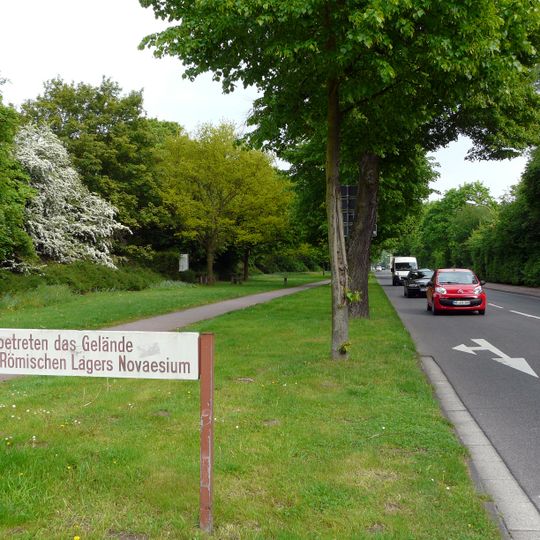
Castra Novaesium is the archaeological site of a Roman legionary camp in the Gnadental district of Neuss, part of the UNESCO World Heritage Lower Germanic Limes since 2021. Nothing of the camp is visible above ground today; a signpost marks the area, and a protected excavation preserves a Roman cult site known as the fossa sanguinis. A historical trail with information panels and copies of large Roman artefacts stands along the former camp perimeter.
A first semi-permanent legionary camp may date to shortly after 20 BC; Drusus used Novaesium as a base in 11 BC. Around AD 30–35 the Legio XX Valeria Victrix was transferred here, followed by the Legio XVI Gallica until 70. After the Batavian revolt a new fortress was built under Vespasian for the Legio VI Victrix, which left around 100–104; an auxiliary fort then replaced it until Franks destroyed it around 275.
The name Novaesium appears in Tacitus' Histories and on the Tabula Peutingeriana as Novesio, between Asciburgium and Colonia Claudia Ara Agrippinensium. Today a sign at the edge of the grounds reads "betreten das Gelände" above "Römischen Lagers Novaesium", and a Historischer Rundgang with copies of large Roman artefacts and information panels marks the former camp.
The site is largely walkable and can be explored on foot, with information panels on the grounds helping visitors orient themselves. A guided visit makes it much easier to read the different zones of the former base.
Parts of the modern street grid in Neuss still follow the layout of the Roman roads that ran through the fort. This hidden pattern beneath the city has quietly shaped its streets for more than 2000 years.
The community of curious travelers
AroundUs brings together thousands of curated places, local tips, and hidden gems, enriched daily by 94,125 contributors worldwide.