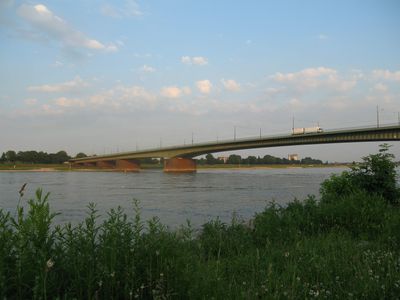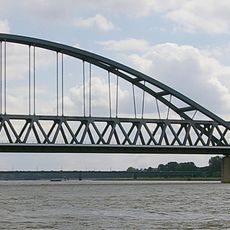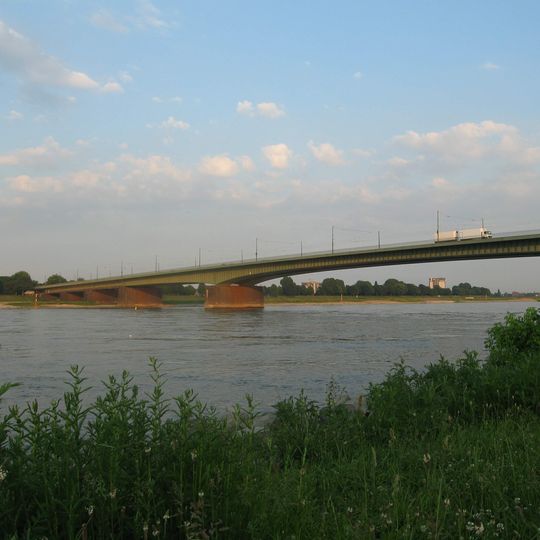
Cardinal Frings Bridge, Girder road bridge in Neuss, Germany.
The Josef-Kardinal-Frings-Brücke is a steel-concrete girder bridge over the Rhine between Düsseldorf-Hamm and Neuss, built 1950–51 on the piers of its 1929 predecessor. Its three-span continuous main beam has a depth varying from 3.3 m at mid-span to 7.8 m over the piers, carried by two closed box girders 7.5 m wide. The light-green bridge is 780 m long and 30.14 m wide, with four road lanes, two tram tracks and outer foot-and-cycle paths.
A first bridge on this site opened on 12 October 1929, carrying a 30.7 m wide deck with a two-track tram line; German Wehrmacht units blew it up on 3 March 1945. The ruined approaches were removed in 1948–49, and the present bridge was built in 1950–51 on the old piers, opening on 17 November 1951. In June 2024 the NRW road authority announced it must be demolished and replaced.
The bridge was renamed on 24 June 2006 after Joseph Cardinal Frings, the Cologne archbishop born in Neuss in 1887. Locals in Düsseldorf still call it Südbrücke, and the press often prints both names in headlines.
The bridge carries four road lanes, two tram tracks of line 709 between Gerresheim Krankenhaus and Neuss, Theodor-Heuss-Platz, and combined foot and cycle paths on both outer sides. The paths are separated from the roadway by metal barriers. The crossing is heavily used at peak times as a feeder to the A57.
The 1951 span was the first bridge anywhere to cross more than 200 metres with a continuous solid-web girder, its depth varying from 3.3 metres mid-span to 7.8 metres over the piers. Factory joints were welded, site joints riveted, and the old 1929 piers were reused, keeping the 103 + 206 + 103 metre layout.
The community of curious travelers
AroundUs brings together thousands of curated places, local tips, and hidden gems, enriched daily by 93,706 contributors worldwide.