Eutin Castle, Cultural heritage castle in Eutin, Germany
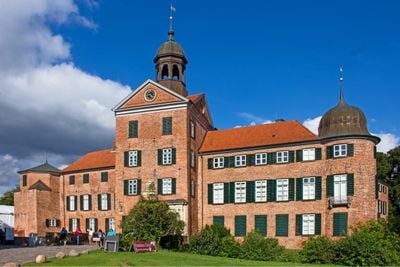
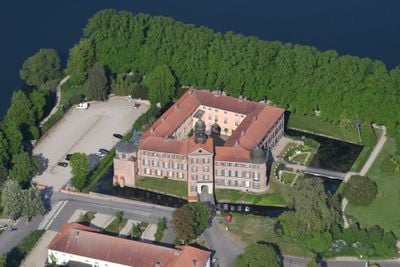
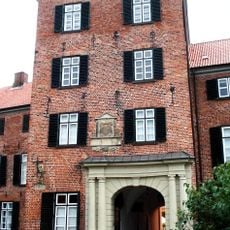
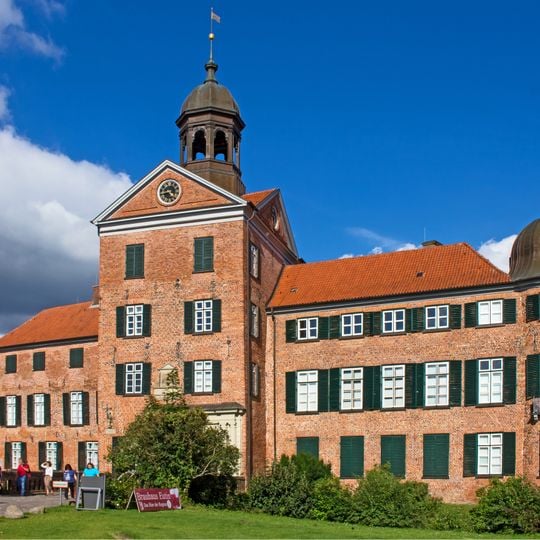
Eutin Castle is a four-winged red-brick palace with pale pinkish-orange upper walls and steep red tiled roofs, grouped around a central courtyard. Four squat round brick towers with dark domed roofs stand at the inner corners. The main entrance is a projecting central section topped by a small domed tower with a clock face, above an arched doorway reached by steps. The building sits directly beside a narrow water channel.
The castle grew from a bishop's residence built by Gerold of Oldenburg after 1156; Bishop Johannes von Tralau expanded it between 1260 and 1275 with a stone building that forms the core of the east wing. A chapel followed in 1293, and by around 1350 it was fortified with a moat. From 1586 the Dukes of Schleswig-Holstein-Gottorf held Eutin and supplied the prince-bishops. A fire in 1689 damaged town and castle, which was rebuilt on the old foundations; in 1705 Danish troops occupied and partly destroyed it. Court architect Rudolph Matthias Dallin remodelled it between 1717 and 1727 into a Baroque residence.
The castle's name lives on in the Eutin Festival, founded in 1951 in honour of Carl Maria von Weber and staged each July and August in the landscape park, with its open-air stage across the Schlossbucht. The bridge into the courtyard is guarded by two figures of fabulous beasts, and a replica of a Roland statue stands above the portal.
Access to the complex is available during the summer months with guided tours offered through the preserved interior rooms. The grounds with their gardens and paths can be explored at a leisurely pace without time pressure.
A small late Baroque hunting lodge on the Ukleisee belongs to Eutin Castle. Frederick Augustus I of Saxony had it built in 1776, at some distance from the main castle, as a single-storey pavilion for hunting parties and guests attending special occasions.
The community of curious travelers
AroundUs brings together thousands of curated places, local tips, and hidden gems, enriched daily by 94,256 contributors worldwide.