Pfahlbaumuseum Unteruhldingen, Open-air museum in Uhldingen-Mühlhofen, Germany.
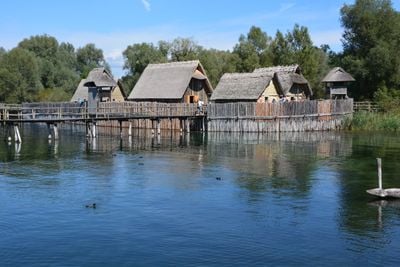
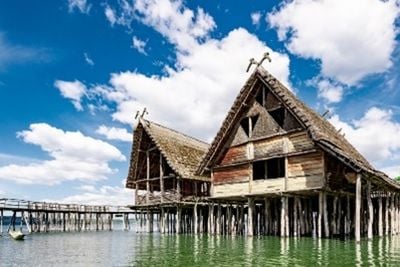
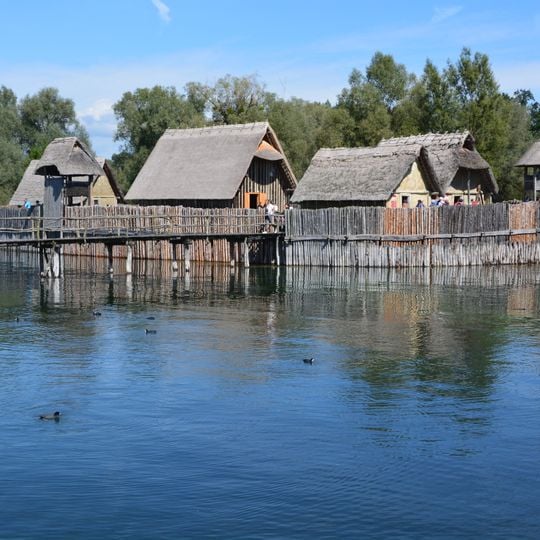
Pfahlbaumuseum Unteruhldingen is an open-air archaeological museum on Lake Constance in Uhldingen-Mühlhofen, Germany. It comprises 23 reconstructed Neolithic and Bronze Age pile dwellings built between 1922 and 2014, including the Bronze Age village "Bad Buchau" (1923–1931) and the Stone Age houses "Riedschachen/Schussenried" (1922). The dwellings stand on wooden piles above the water, with steep thatched or shingled roofs and walls of vertical planks; wooden walkways and stake fences connect them.
The museum opened in summer 1922, after the Association for Pile Dwelling and Local History was founded on 12 March 1922 on the initiative of mayor Georg Sulger. Its first two stilt houses were built under the guidance of the Prehistoric Research Institute Tübingen, based on excavations in a bog near the Federsee at Bad Schussenried in 1920, where a Neolithic settlement of 4000 BC was found. Further reconstructions followed up to 2014, when ARCHAEORAMA opened.
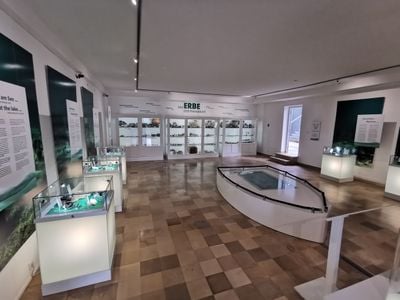
Stone and bone tools sit beside reconstructed looms and hearths from the Stone and Bronze Age periods. Visitors see how clay storage vessels were arranged and how fishing nets hung from the rafters of these waterside homes.
The wooden walkways between houses can become slippery when wet, so sturdy footwear is advisable. Wheelchair users should inquire in advance as not all areas are accessible without steps.
The museum's 23 dwellings include the Bronze Age village "Bad Buchau", built between 1923 and 1931, and the "Unteruhldingen" group from 1999–2002. The first two houses, erected in 1922, reproduce a Neolithic settlement of 4000 BC excavated in 1920 in a bog near the Federsee by Bad Schussenried.
The community of curious travelers
AroundUs brings together thousands of curated places, local tips, and hidden gems, enriched daily by 92,783 contributors worldwide.