Alte Burg, Medieval castle ruins in Bad Münstereifel, Germany.
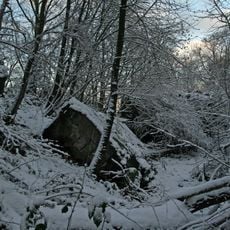
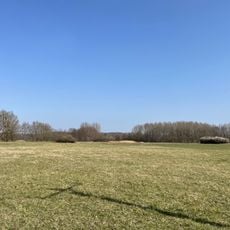
Alte Burg is a Carolingian circular rampart, the remnant of a refuge fortification, on the second Quecken hill spur northeast of Bad Münstereifel's centre above the Erft valley. The defended area measures about 300 by 80 metres, excluding the outworks, and was built in at least two phases; a motte lies in the northeast. At the highest point survives the rubble-stone foundation of a round tower.
The Alte Burg is a Carolingian refuge castle (Fliehburg) from the 9th century, built in at least two construction phases; a motte stands in the northeast. It served the local population as a place of retreat and protected the daughter monastery of Prüm Abbey. The site was archaeologically investigated in 1972, when 9th-century pottery with roller-stamp decoration was found.
The site is a refuge castle (Fliehburg): in times of danger the population of the Prüm Abbey daughter monastery and the surrounding area withdrew behind its rampart. The name Quecken refers to the hill spur above the Erft valley. Pottery shards with roller-wheel decoration found in 1972 show 9th-century everyday ware.
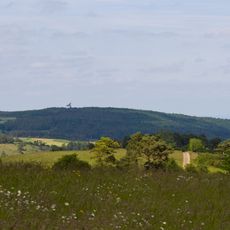
The site sits between 315 and 363 meters above sea level on a hilltop with open views of the surrounding area. Visitors should expect uneven ground and slopes that require sturdy footwear for safe movement.
In 1972, excavations uncovered 9th-century pottery sherds decorated with roller-stamped patterns, evidence of the site's Carolingian date. A silver coin of Louis the Pious is said to have been found in the round tower's rubble foundation in the 19th century, but it has not survived, so the claim rests on report alone.
The community of curious travelers
AroundUs brings together thousands of curated places, local tips, and hidden gems, enriched daily by 92,872 contributors worldwide.