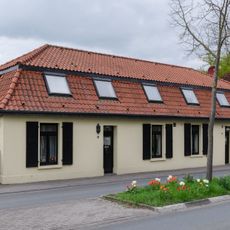
Alte Kellnerei, building in Rheinberg, Germany
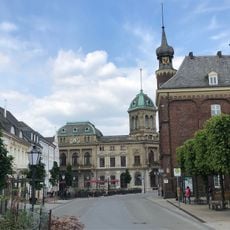
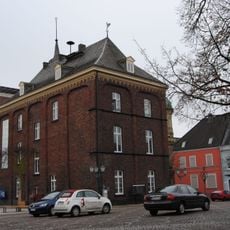
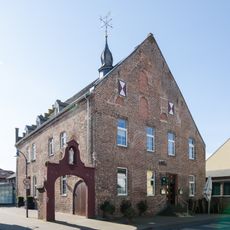
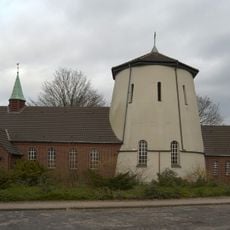
The Alte Kellnerei is a two-storey brick building, the only surviving structure of the former electoral Cologne castle of Rheinberg. Its ground floor preserves 17th-century painted wooden beam ceilings, unique in the Rhineland, with poplar wood in red, blue, green and light grey. A ceiling fresco on white ground shows foliage, pomegranates, squirrels, birds and lion heads, and a strip of late 18th-century secco wall painting survives.
The Kellnerei was built in 1573 as an outbuilding of the Electoral Cologne castle of Rheinberg, serving as a grain magazine for the revenues of the Amt Rheinberg and partly as a stable. In October 1598 the powder tower exploded during the Spanish siege under Francisco de Mendoza, destroying most of the town and castle; only parts of the Kellnerei and one tower survived. From 1627 it was rebuilt and converted, with the west wing raised for the Schultheiß and the east wing turned into an armoury. In 1794 it passed into private ownership, and the town bought it in 1979.
The name Kellnerei comes from the Kellner, the official who managed the Rheinberg district's grain revenues stored here. The west wing housed the Schultheiß, the Kellner and Cologne officials, later also fortress governors, while the east wing served as an armoury. Since 1994 the building has housed the Rheinberg music school, the town archive and exhibition rooms.
The building is open to the public and houses the city archive where visitors can learn about Rheinberg's history, plus a model of the town center to help plan walking tours. Tours are scheduled through the city's website and should be arranged in advance.
This is the only surviving building from the medieval castle of Rheinberg, which was largely destroyed in a 1598 explosion. Its survival makes it a rare physical link to the region's medieval town layout and castle infrastructure.
The community of curious travelers
AroundUs brings together thousands of curated places, local tips, and hidden gems, enriched daily by 94,420 contributors worldwide.