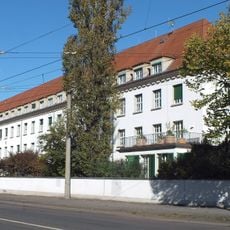
Leipzig Botanical Garden, Botanical research garden at University of Leipzig, Germany.
Leipzig Botanical Garden is a research facility spanning 3.5 hectares with over 7,000 plant species representing diverse climates and regions. Five modern greenhouses shelter tropical and subtropical plants, while outdoor sections display native and temperate species, along with a dedicated butterfly house.
The garden began as a hortus medicus on the former monastery garden north of the Paulinerkirche, reworked by May 1543 after Duke Moritz of Saxony gave the university the Dominican monastery of St. Pauli. It was devastated in the Thirty Years' War and abandoned in 1641; a second garden followed in 1653 on the Grimmaische Gasse, a third in 1806/07 at the Pleißemühlgraben, and the present site at Linnéstraße in 1876/77, when the Reichsgericht was built on the old grounds.
The garden's name honours Carl Linnaeus: its address is Linnéstraße, and the systematic beds group plants by family so students can compare related species. The outdoor marsh and pond hold regional flora, while the greenhouses display plants from the Mediterranean, Africa, Central America and Australia. A butterfly house has operated here since 1996.
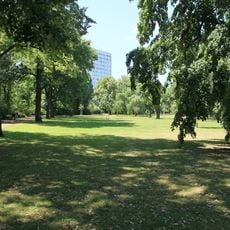
The garden lies on a near-triangular plot between Johannisallee to the west, Linnéstraße to the east and Philipp-Rosenthal-Straße to the south, with the main entrance on Linnéstraße and two side entrances on Johannisallee. The Friedenspark, the former Neuer Johannisfriedhof, borders it across Linnéstraße, and the university hospital stands across Johannisallee. It is about 2.5 km from the city centre.
Three plants survive from before the Second World War: a strawberry tree, a bottlebrush and a pomegranate, kept as cold-house plants after the bombing of 27 February 1945 killed almost all greenhouse stock. The strawberry tree is still cultivated today.
The community of curious travelers
AroundUs brings together thousands of curated places, local tips, and hidden gems, enriched daily by 93,450 contributors worldwide.