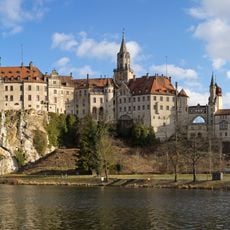
Amalienfelsen, Rock formation in Inzigkofen, Germany.
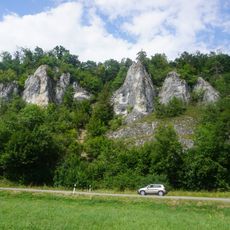
Amalienfelsen is a 29-metre-high limestone rock from the White Jurassic period on the right bank of the Danube in the Fürstlicher Park at Inzigkofen. Its vertical river-facing wall bears cast-iron letters reading "Andenken an Amalie Zephyrine 1841" and the alliance coat of arms of the princess who died that year. The rock stands at 605 metres above sea level, 113 metres lower than the Danube source at Donaueschingen, and is a geotope protected by the LGRB.
The formation was renamed in 1841 to honor a royal figure, replacing earlier names such as Bleifelsen or Blaufelsen. This change in naming reflects how the site was reinterpreted and given new meaning during that period.
The rock face displays cast iron letters that mark a royal connection, making it recognizable from various points along the river. This inscription gives the formation a personal identity that visitors notice as they walk through the park.
The rock stands on the right bank of the Danube inside the Fürstlicher Park at Inzigkofen and is freely accessible to everyone, as it is owned by the House of Hohenzollern-Sigmaringen. The gorge here marks the exit of the Danube breakthrough through the Swabian Alb; the most pronounced section lies 40 kilometres upstream near Beuron.
The rock is a protected geotope listed by the Freiburg state office for geology, raw materials and mining (LGRB). Its summit stands at 605 metres above sea level, 113 metres lower than the Danube source at Donaueschingen. The narrow point here marks the exit of the Danube breakthrough through the Swabian Alb.
The community of curious travelers
AroundUs brings together thousands of curated places, local tips, and hidden gems, enriched daily by 94,136 contributors worldwide.