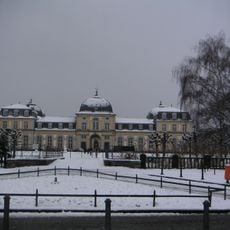
Meckenheimer Allee 166–168, Historical university building in Poppelsdorf, Bonn, Germany.
The Altes Chemisches Institut at Meckenheimer Allee is a large four-wing complex built between 1864 and 1867 with varying roof heights that create visual interest. The structure displays harmonious proportions with systematically arranged laboratory and office spaces organized in a clear hierarchical order.
The institute was established in the mid-1800s and became the world's largest university chemistry facility upon completion. Its creation marked a turning point in scientific education within German-speaking regions.
Before the building stands a statue of Friedrich August Kekulé von Stradonitz, carved by sculptor Hans Everding in 1903; Kekulé worked at the Chemical Institute from 1867 to 1896. On 9 May 2014 a memorial plaque honouring Kekulé was unveiled there as part of the Historic Sites of Chemistry programme.
The building now houses the Institute of Microbiology and Biotechnology and the Geographical Institute of the University of Bonn, so it is a working academic site rather than a museum. The main entrance lies in the eastern side wing, with the director's room placed symmetrically in the western wing. The Kekulé statue by Hans Everding stands in front of the building on Meckenheimer Allee.
The lecture hall occupied the wide central tract, while the director's room was placed symmetrically opposite the main entrance in the west wing. The street front is two storeys high, closed by two corner pylons of two and a half storeys; the side and rear wings were originally single-storey.
The community of curious travelers
AroundUs brings together thousands of curated places, local tips, and hidden gems, enriched daily by 95,014 contributors worldwide.