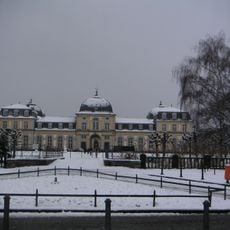
Goldfuß-Museum, Fossil and university museum in Bonn, Germany.
The Goldfuß-Museum occupies the first floor of the Steinmann-Institut at Nußallee 8 in Bonn, in a 1911 building by Robert Schulze. Its systematic collection shows petrified marine animals and plants, with dinosaur skeletons including a T. rex skull, a plesiosaur and a four-metre ichthyosaur in the rear hall; the front room hosts temporary exhibitions.
The collection traces back to the university's founding on 18 October 1818, when Georg Goldfuß brought the natural science institutes to Poppelsdorf Castle and directed the natural history museum until 1848. The paleontological museum moved into the main university building in 1882, then into the new Nußallee 8 building in 1911 on Gustav Steinmann's initiative. After decades open only to specialists, it has been accessible to the general public again since the early 1990s.
The museum is named after Georg August Goldfuss, a German paleontologist and zoologist whose scientific work continues to guide its collections. Visitors can see how fossils are traditionally studied and displayed in a scientific setting.
The museum is located at Nussallee 8 and is accessible by public transportation. Visitors should check current opening hours in advance since they may vary, and guided tours can be arranged with prior notice.
The staircase columns of the 1911 building are cut from three different rocks: granite on the ground floor, limestone on the middle level and Buntsandstein above, chosen by architect Robert Schulze to stand for successive geological periods. The Latin motto over the portal, Mente et malleo, means "think first with the mind, then strike with the hammer".
The community of curious travelers
AroundUs brings together thousands of curated places, local tips, and hidden gems, enriched daily by 94,501 contributors worldwide.