Sondershausen Palace, Royal palace in Sondershausen, Germany.
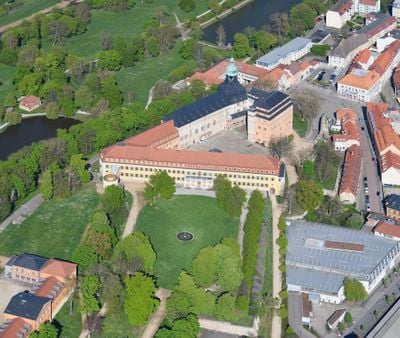
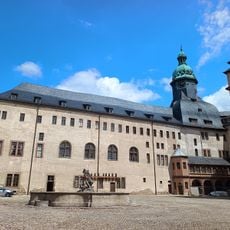
Sondershausen Palace is an irregular four-wing complex of pale beige masonry with rows of rectangular windows, its long wing under a steep red-brown tiled roof with dormers along the ridge. A taller block with five dormers and a small domed tower closes the courtyard, and an arched arcade runs along the base of the far wing. The Berlin architect Carl Scheppig gave the complex its present appearance in the 19th century.
Construction of the palace began under Count Günther XL of Schwarzburg in the 1530s and continued through the 1550s. Over the centuries, various architectural styles were added, significantly altering the complex's appearance.
The Giant's Hall displays 22 ceiling paintings depicting scenes from Ovid's Metamorphoses, accompanied by large stucco figures representing Greek deities that shape the room's appearance.
The palace stands on the eastern edge of the old town, with Carl Scheppig's palace terrace, staircase and guard house linking it directly to the market square. The museum and the Carl-Schroeder-Konservatorium share the building, so some rooms are in teaching use. The complex is an irregular four-wing layout, and the terrace steps between market level and the hilltop courtyard involve climbs.
The Stone Room keeps its original 1770s decoration: walls covered in small cut, polished and glazed tiles of plaster and limestone. Because of this shimmering surface it is called the "Amber Room" of Sondershausen. Look for the tiling rather than any painting or stucco work.
The community of curious travelers
AroundUs brings together thousands of curated places, local tips, and hidden gems, enriched daily by 93,097 contributors worldwide.