Yavuz Sultan Selim Mosque, Central mosque in Mannheim, Germany
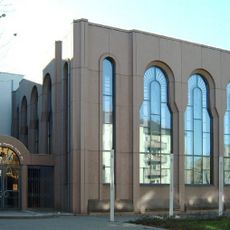
The Yavuz Sultan Selim Mosque stands in the eastern Jungbusch district of Mannheim on the Innenstadtring, part of the busy Bundesstraße 44, directly next to the Liebfrauenkirche. It is a domed building with a 35-metre minaret, flanked by two three-storey residential blocks whose round stairwells lead over into the mosque. Above ground-floor shops sits a triangular oriel that marks the prayer niche facing Mecca; inside are a hall, classrooms and a marble fountain in the washing room. The prayer hall for men on the first floor holds 2,500 people, 500 of them on the women's gallery, under a dome decorated with calligraphy.
The mosque opened in 1995 and was at that time the largest Islamic house of prayer in Germany. It was built to give the growing Muslim community in Mannheim a permanent place for worship.
The mosque is run by the Ditib Türkisch Islamische Gemeinde zu Mannheim e. V., chaired since 2022 by Hızır Oymak. Its name honours Sultan Selim I, called "Yavuz" (the Stern, the Cruel). A tulip-shaped crystal-glass chandelier in the prayer hall was a gift from Mannheim's Christian churches and Jewish community, and the affiliated institute has run an "Open Mosque" programme since 1996.
The building is open to visitors during the day, and guided tours can be arranged with prior notice. Modest clothing is expected, and it is worth checking prayer times before you arrive to avoid any disruption.
The circular shape of the prayer hall is very rare in Islamic religious architecture, where rectangular rooms are by far the most common. This layout means that all worshippers stand at a roughly equal distance from the direction of Mecca.
The community of curious travelers
AroundUs brings together thousands of curated places, local tips, and hidden gems, enriched daily by 94,083 contributors worldwide.