Pfaueninsel, Protected island in Wannsee, Germany.
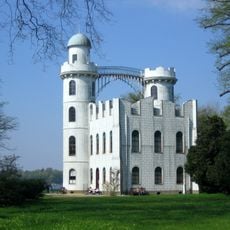
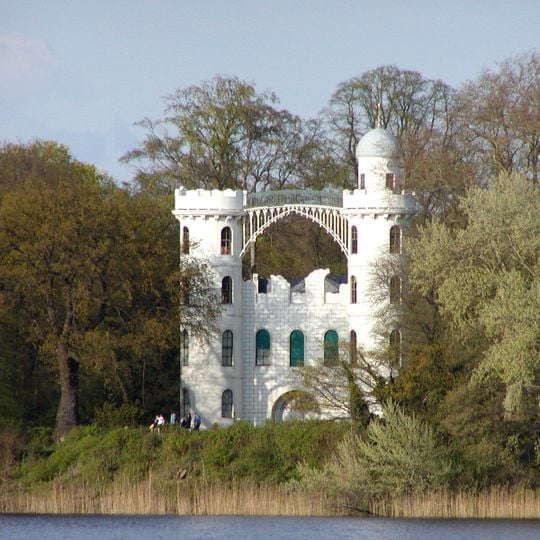
Pfaueninsel is a 67-hectare island in the Havel in Berlin-Wannsee, part of the UNESCO World Heritage Site of the Palaces and Parks of Potsdam and Berlin. Its small palace, built 1794–97, stands on the western tip: a white building with two round towers joined by an open arch, the left tower crenellated, the right capped by a green dome, with a pointed white lattice hanging beneath the arch.
Friedrich Wilhelm II acquired the island in 1793 and had the palace built the following year to create a retreat for summer stays. Before that, the site served as a warren for rabbit breeding until it was transformed into a royal landscape park.
The name Pfaueninsel (Peacock Island) was already in use by 1795, before the birds arrived; older names were Kaninchenwerder and Pauwerder. Frederick William III later kept a menagerie of over 900 animals from more than 100 species, peacocks among them, and let Berliners visit three days a week. Free-ranging peacocks still walk the island today.
The island is reached only by a small ferry from the Wannsee shore; bus line 218 connects the Wannsee station to the ferry landing. Paths cross mostly level ground, and the entire island is a nature reserve, so visitors stay on marked trails. The garden staff recommends allowing several hours to walk from the palace at the western tip to the dairy at the other end.
In the late 17th century, the alchemist Johann Kunckel ran a secret laboratory here, whose experiments sparked rumors of witchcraft among local residents. His attempts to produce ruby glass later contributed to the development of new glass techniques.
The community of curious travelers
AroundUs brings together thousands of curated places, local tips, and hidden gems, enriched daily by 92,664 contributors worldwide.