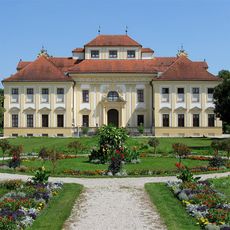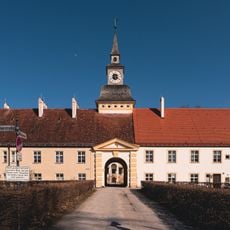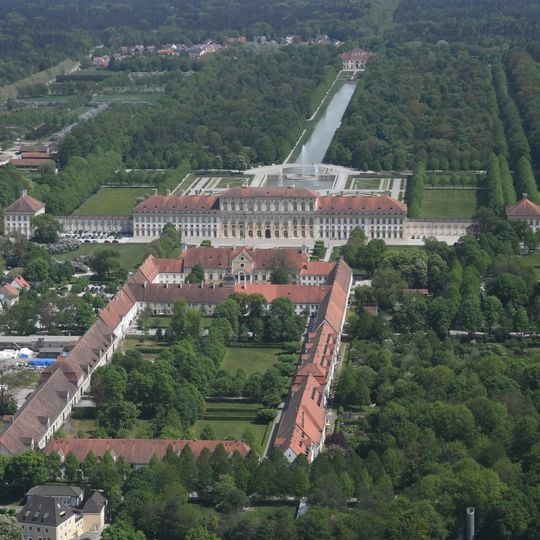
Schleißheim palace complex, Royal palace complex in Oberschleißheim, Germany.
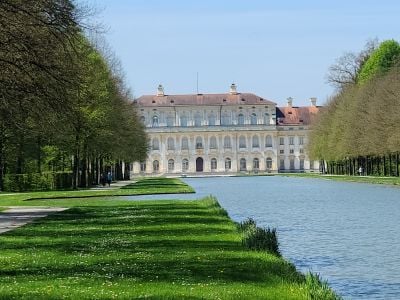
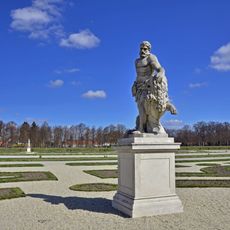
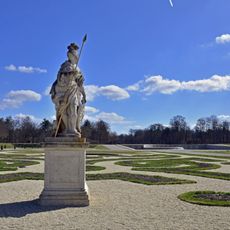
Schleißheim palace complex comprises three palaces connected by formal gardens, symmetrical canals, and decorative parterres arranged across the grounds. The garden design demonstrates careful geometric planning typical of baroque estates.
Duke Wilhelm V acquired a Schwaige with a chapel from the Freising cathedral chapter in 1597 and built a manor house there from 1598 to 1600. His son Maximilian I replaced it with the Old Palace between 1617 and 1623. Max Emanuel added Lustheim Palace by 1688 and began the New Palace in 1701, but only its east wing was completed.
The name Lustheim, used for the garden palace at the east end of the park, signals its role as a pleasure and hunting retreat rather than a permanent residence. The New Palace's dome fresco by Cosmas Damian Asam shows Venus in Vulcan's forge, and the face of Aeneas bears the features of Elector Max Emanuel. The Grand Staircase by Enrico Zuccalli was later taken up by Balthasar Neumann at Augustusburg and the Würzburg Residence.
Access is easy via the Munich S-Bahn line 1, with multiple exhibition rooms and garden areas to explore. Plan extra time for your visit, as the grounds are extensive and require several hours to see everything properly.
Duke Wilhelm V founded a brewery in the Wilhelmshof in 1598, and Schleißheimer Bier came from it. The complex also kept a collection of paintings made for it, including four monumental hunting pieces by Peter Paul Rubens, one of which now hangs in the Alte Pinakothek.
The community of curious travelers
AroundUs brings together thousands of curated places, local tips, and hidden gems, enriched daily by 92,808 contributors worldwide.