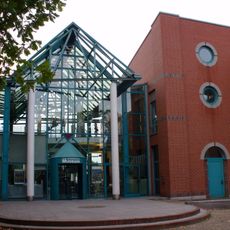
Werhahnmühle, Office building in Duisburg-Mitte, Germany
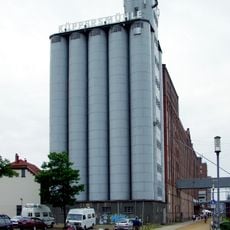
The Werhahnmühle stands on both sides of the Speichergracht at Duisburg's Inner Harbour. Its brick warehouses of 1896 and 1899 have pitched roofs and timber or cast-iron interior supports; the mill itself, rebuilt in reinforced-concrete skeleton form after the 1924 fire, shows a regular wide row of windows from the roller mills inside. A concrete silo with brick cladding, built in 1938, held up to 12,000 t of grain.
Jacob Cohen built the first mill here in 1896; after a fire in 1924 his sons Wilhelm and Hugo rebuilt it in reinforced-concrete skeleton form, with the Werhahn cousins of Neuss taking a 25% stake that year. On 3 January 1936 the Werhahn partners acquired the firm outright and renamed it Rheinische Mühlenwerke Herm. & Wilh. Werhahn oHG; the Jewish Cohen family escaped to South America. Milling stopped in 1969, state grain reserves stayed until 1994, and a citizens' initiative blocked demolition.
The building is part of the Duisburg Inner Harbor district and shows how old industrial structures find new purposes. Visitors can explore museums, offices, and restaurants today in spaces that once served industrial production.
The complex sits on both sides of the Speichergracht directly on the Inner Harbour, with restaurant terraces on the gracht and a pontoon on the harbour promenade. The larger warehouse, now Business-Kontor IN'N Hafen, holds around 12,500 m² of offices. The children's museum in the former mill continues the Atlantis tradition as Explorado since May 2013.
The storage areas served as state grain reserves until 1994, continuing their original purpose decades after the mill stopped operating. These spaces tell an unusual story of repurposing across different eras.
The community of curious travelers
AroundUs brings together thousands of curated places, local tips, and hidden gems, enriched daily by 93,875 contributors worldwide.