Baier, Mountain summit in Rhön region, Germany
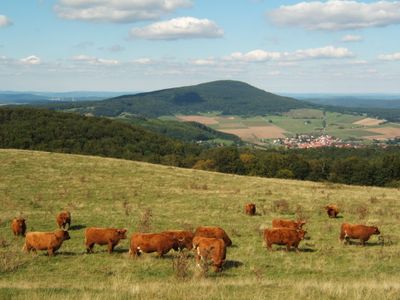
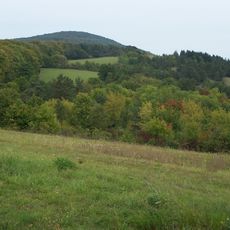
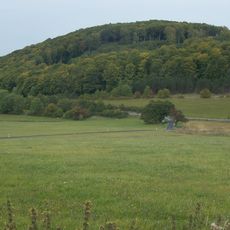
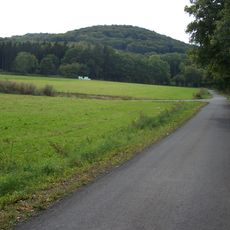
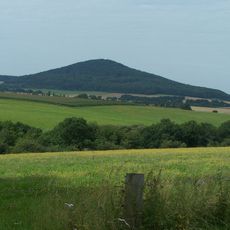
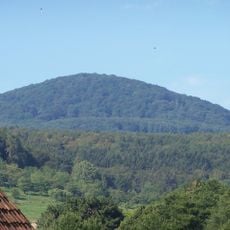
Baier is a 713.9 m high cone-shaped volcanic mountain at the northern edge of the Rhön in Thuringia, within the Auersberg Kuppenrhön. Two concentric ring walls of basalt boulders encircle the summit plateau: the inner ring lies about 15 m below the top, the outer about 30 m. The enclosed area covers roughly 3 hectares, and the cone shape is most visible from the north.
The mountain was settled as far back as the Bronze Age and early Iron Age, as shown by nine burial mounds on its slopes. A surveying signal was placed on its peak in the early 1800s.
The name Baier is not tied to a family; the summit plateau is ringed by two concentric walls of basalt boulders, the inner about 15 m below the top and the outer about 30 m, enclosing roughly 3 hectares. Pottery found there dates the enclosure to the pre-Roman Iron Age. Gaps in the outer wall are read as gateways.
The main T4 long-distance trail runs along the eastern slope from Dermbach to Vacha; from the car park at the Emberghütte it can also be walked over the lower Emberg near Oberalba. The Rhönclub Dermbach has signposted direct ascents starting in Unteralba, Weilar and Gehaus. The conical shape is clearest from the north.
A wooden lookout tower called the Karl-August Tower stood on the peak from 1914 until a fire destroyed it in 1988. Local hikers still recall stories about the structure and its place in the mountain's past.
The community of curious travelers
AroundUs brings together thousands of curated places, local tips, and hidden gems, enriched daily by 93,753 contributors worldwide.