Basilica of St. Martin, Baroque papal basilica in Weingarten, Germany
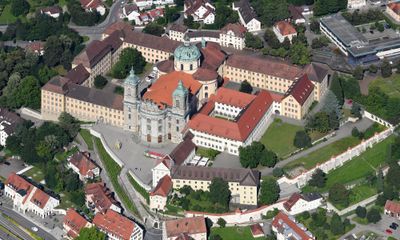
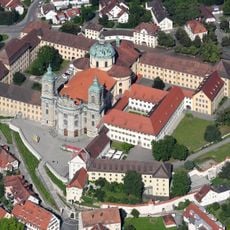
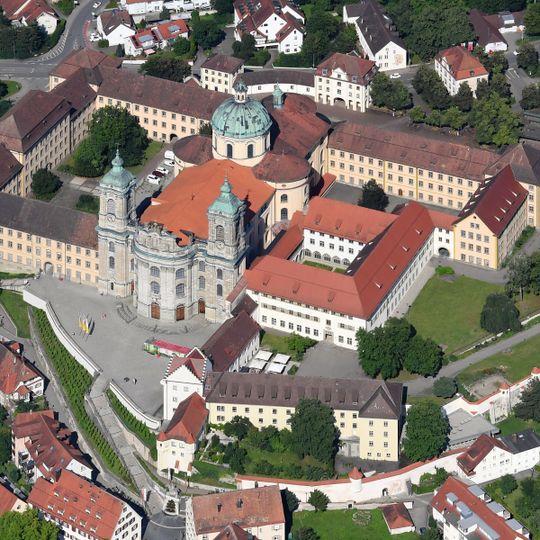
The Basilica of St. Martin is a Baroque former abbey church in Weingarten, 102 metres long with a 67-metre dome, making it Germany's largest Baroque church. Its seven-axis facade has two towers with green domed caps, a volute-crowned gable holding a Marian statue, and five portals. Inside is a white-walled gallery hall of seven sections, with ceiling frescoes by Cosmas Damian Asam (1718–1720) and stucco by Giacomo Antonio Corbellini.
A Romanesque church founded in 1056 by Welf IV as the Welf burial site preceded the present building. The cornerstone of the Baroque replacement was laid on 22 August 1715 under Abbot Sebastian Hyller, with Donato Giuseppe Frisoni as master builder from 1717. Bishop Johann Franz Schenk von Stauffenberg of Constance consecrated it on 10 September 1724. The abbey was dissolved in 1803, and Pope Pius XII raised the church to a minor basilica in 1956.
The Heilig-Blut relic kept in the church is venerated across Upper Swabia and is carried each year in the Blutritt, one of Europe's largest mounted processions. Since 2010 the parish has been responsible for the pilgrimage. A dispute since the mid-2020s concerns the neo-Baroque high altar from the 1930s that displays the relic.
Visitors can enter freely during daytime hours and explore the church at no cost. It is advisable to be respectful and dress appropriately, especially if religious services are taking place.
The organ was built by Josef Gabler (1700–1771), the best-known South German organ builder of the Baroque era. The church's plan, probably by Franz Beer, was to make it the centre of a symmetrical abbey complex; construction of the north and south wings began in 1727 but was stopped in April 1728 by the government of Further Austria, so the scheme was never completed.
The community of curious travelers
AroundUs brings together thousands of curated places, local tips, and hidden gems, enriched daily by 94,068 contributors worldwide.