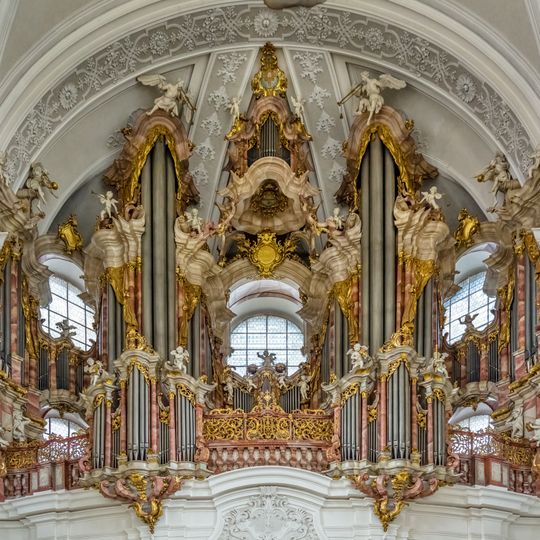
Organ of the Basilica of St. Martin, Baroque pipe organ in Weingarten, Germany
The Organ of the Basilica of St. Martin is a large Baroque instrument with 63 stops and nearly 7000 pipes arranged across seven divisions. The structure uses multiple towers of different heights to accommodate pipes of varying lengths.
Joseph Gabler signed the first contract on 6 July 1737; a fire in the monastery buildings and the abbey's financial troubles delayed the work, and the organ was consecrated on 24 June 1750. Gabler, an excellent craftsman but a poor businessman, was financially ruined by the project. The free-standing console is one of the earliest of its kind.
The pedal carillon's shell bells are arranged as grape bunches, a nod to Weingarten and the wine-growing region north of Lake Constance. The 49-rank mixture La Force sounds only on the pedal's low C and was used to signal the start of celebrations. The Vox-humana legend, first written down in 1922 by organist Franz Bärnwick, tells of a secret lever; Karl Weinberger's mystery play Vox humana was premiered on the Münsterplatz in 1930.
The free-standing console, one of the earliest of its kind, is richly inlaid and has stop knobs of solid ivory; the keys respond heavily because of the long mechanical action. The organ gallery also holds the pedal carillon, whose shell bells are arranged as bunches of grapes.
The pedal carillon's shell bells are arranged above the console as grape bunches, a nod to Weingarten's wine-growing region. The 49-rank mixture La Force sounds only on the pedal's low C and was used to signal the start of celebrations. The Vox humana legend tells of a secret lever Gabler supposedly built in; a 1922 account by organist Franz Bärnwick spread the story, and a valve was reinstalled during the 1981–83 Kuhn restoration.
The community of curious travelers
AroundUs brings together thousands of curated places, local tips, and hidden gems, enriched daily by 93,121 contributors worldwide.