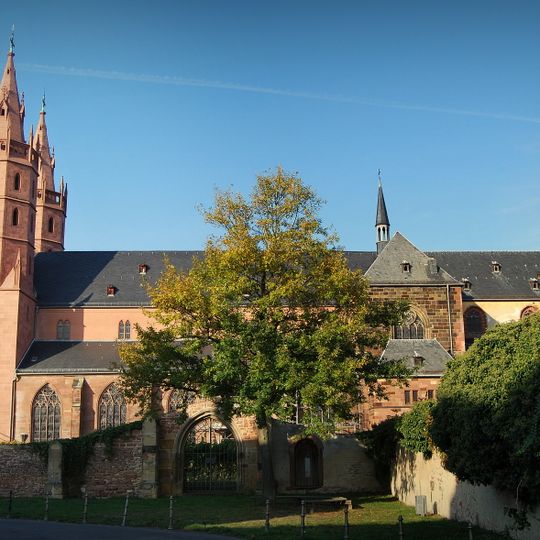
Liebfrauenkirche, Gothic church in Worms, Germany
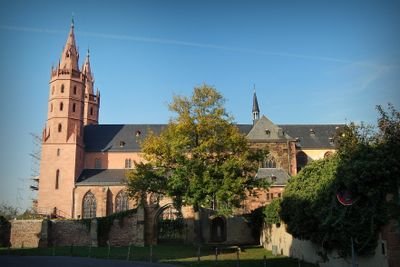
The Liebfrauenkirche is a Gothic church built from 1276-1277 over two centuries, with an east-oriented choir, a nave with side aisles, a west front with two towers, and a south portal with figure sculptures. It is the only surviving Gothic church in Worms and stands within a green area north of the old town.
Construction began in the 1270s, and indulgences from the bishops of Würzburg, Speyer and Bamberg in 1276 and 1277 document the start. On 31 October 1298 Bishop Emich I Raugraf von Baumburg raised the pilgrimage chapel to a collegiate church with twelve canons. The west portal was finished in 1381, the tracery windows were made between 1450 and 1465, and a wall inscription at the north-west crossing pier is dated 14 September 1465.
The church's name gave rise to Liebfrauenmilch, the wine from vineyards once cultivated around it. A Marian pilgrimage is documented from 1499, and in 1495 Emperor Maximilian I and his wife Bianca visited during the Diet of Worms. The figure of Mary was removed in 1565 during Reformation iconoclasm.
The church stands north of Worms' old town, at the junction of Liebfrauenstift and Liebfrauenring, inside a large green space with the vineyards that gave Liebfrauenmilch its name. It is oriented to the east; the west portal with its figure cycle and the 1465 wall inscription on the north-west transept pier are the details to seek out.
The vineyards beside the church gave their name to Liebfrauenmilch, the wine known in English as Liebfraumilch. The church stands on open ground north of the old town, between the inner and outer medieval walls, because the area inside the outer ring was barely built up in the early modern period.
The community of curious travelers
AroundUs brings together thousands of curated places, local tips, and hidden gems, enriched daily by 94,637 contributors worldwide.