Albert-Schulte-Park, Cultural heritage park in Worms, Germany
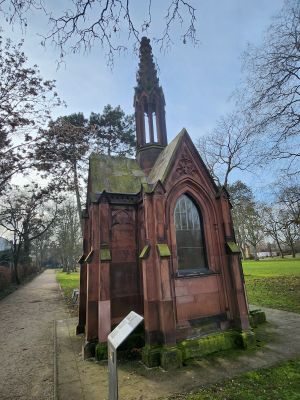
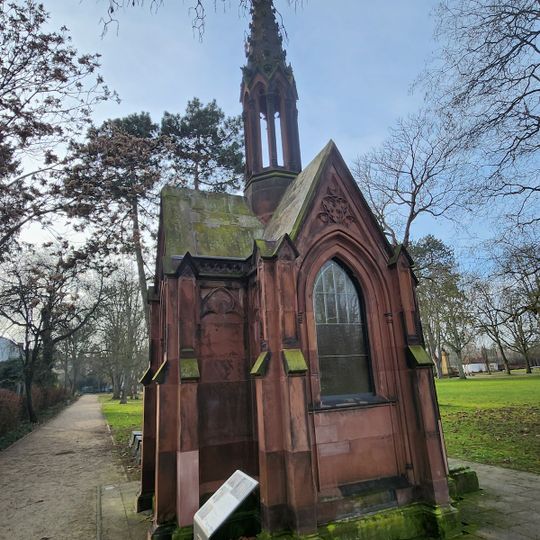
Albert-Schulte-Park is a park in Worms created from the abandoned Old Cemetery, whose path network largely survives from that time. It is bounded by Gaustraße, Renzstraße, Goethestraße and the north head of Worms Central Station. Preserved along the paths are ornate grave monuments, including the neo-Gothic Doerr and Reinhart burial chapel and the Keim family tomb at the southern wall.
Worms opened the Alte Friedhof in 1840 to replace three older burial grounds north of the city; a mortuary followed in 1856. The cemetery closed in 1878, full and hemmed in by the town's growth toward the railway station, and was succeeded by the Rheingewannfriedhof. In the early 1890s the state and the Hessische Ludwigsbahn failed to take the site for station expansion, and plans from the late 19th century to turn it into a park were carried out in the 1920s.
The park's name honours Albert Schulte, who became full-time mayor of Worms in 1924, the year the cemetery was converted into a green space. Among the graves kept along the southern wall is the family tomb of the Keims; Pastor Eduard Keim, buried here, was the main initiator of the Luther Monument in Worms.
The park lies northwest of Worms city center, bordered by Gaustraße, Renzstraße, and Goethestraße near the main train station. The easiest way to navigate is to enter from these surrounding streets and follow the pathways within.
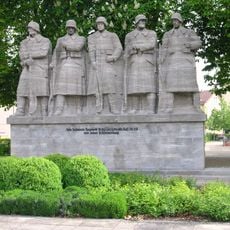
The park's name dates only from the 1960s redesign, when the former mortuary was demolished and replaced by a fountain and a mini-golf course was added in the north. The cemetery's path network survives largely intact and forms a protected monument zone with the historic graves and war memorials.
The community of curious travelers
AroundUs brings together thousands of curated places, local tips, and hidden gems, enriched daily by 93,172 contributors worldwide.