Heylshof, Art museum and villa garden in Worms, Germany
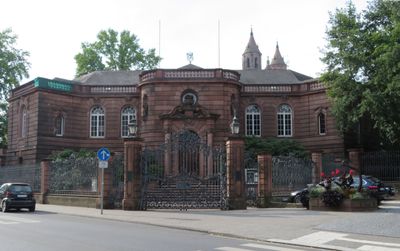
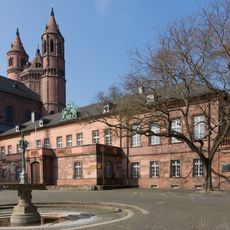
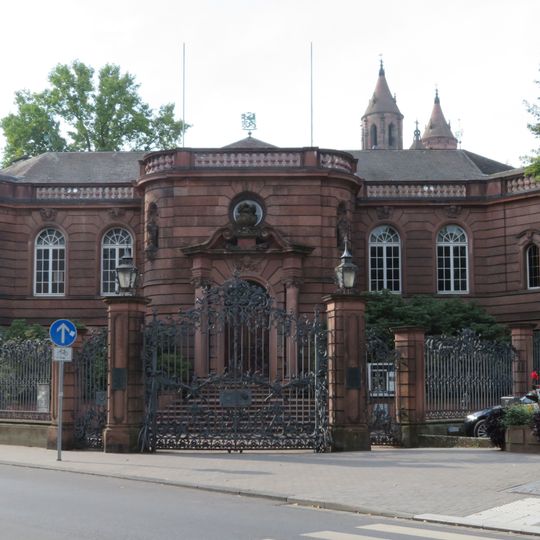
Heylshof is a neo-baroque villa built 1881–1884 by Swiss architect Alfred Friedrich Bluntschli for Cornelius Wilhelm and Sophie von Heyl, now the Kunsthaus Heylshof museum. The red sandstone building has a rounded central pavilion with a balustraded top, flanked by lower wings with arched windows; behind rise two dark spires. A wrought-iron gate with spikes fills the arched entrance, and a blue sign with a white arrow stands at the left.
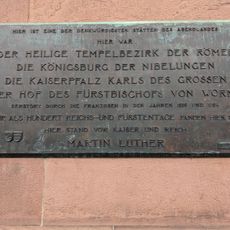
The Heyl family acquired the land from 1805. Its eastern part had held the Bishops' Court, built on the site of the original royal palace; the last building, erected 1719–1725 with Balthasar Neumann involved, was destroyed in 1794. The present neo-baroque villa was built 1881–1884 by Alfred Friedrich Bluntschli for Cornelius Wilhelm and Sophie von Heyl, damaged in a 1945 air raid and rebuilt with one storey and a hipped roof.
The name honours the Heyl family, who acquired the land from 1805 and had the neo-baroque villa built in 1881–1884 by Alfred Friedrich Bluntschli. Cornelius Wilhelm and Sophie von Heyl bequeathed building and garden to the Kunsthaus Heylshof foundation. During the Nibelungenfestspiele the garden serves as the theatre foyer.
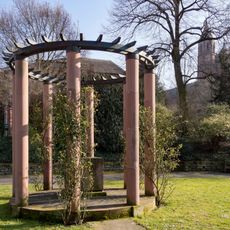
The museum building is reached through the wrought-iron gate and up an outdoor staircase to the portal with Lorenz Gedon's carved wooden doors. The garden is bounded on the west by the remains of the medieval city wall, closed off on the northwest by the Hercules Fountain. A cellar entrance to the cathedral from 1719 survives in the grounds, now barred.
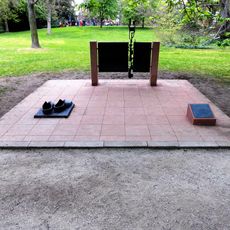
The memorial "Die Großen Schuhe Luthers" (Luther's Great Shoes) was installed in 2017 at the eastern end of the grounds, roughly where Luther met Emperor Charles V at the Bischofshof in 1521. The bronze shoes are easy to miss at the far edge of the garden.
The community of curious travelers
AroundUs brings together thousands of curated places, local tips, and hidden gems, enriched daily by 94,012 contributors worldwide.