Johanneskirche, Former church site in Worms, Germany
St. Johannes in Worms was a decagonal central building with an upper and a lower church, its axis shifted from the usual east-west line to east-east-south / west-west-north. The main entrance lay at the western end, and three shallow choirs were attached to the decagon, the middle one at the eastern end. The tower stood partly on the arch of the southern choir and was smaller than some depictions suggest.
St. Johannes was first documented in 1200 and dated by its style to the last third of the 12th century, built around 1170 with its outer ambulatory, the central structure following about ten years later. It passed early to the city parish and its lower church served as a charnel house for the small Johannisfriedhof. In 1796/97 French troops used it as a magazine; the furnishings were auctioned in 1801 and the building itself on 26 January 1807, then demolished before 1812.
The church was dedicated to John the Baptist. Its lower church served as a charnel house for the small Johannisfriedhof cemetery in front of it. In 1796/97 French revolutionary troops used the building as a magazine. About 90 spolia are kept in the Museum der Stadt Worms, with further fragments in Frankfurt's Liebieghaus, the Kurpfälzisches Museum Heidelberg, the Dom- und Diözesanmuseum Mainz and the Germanisches Nationalmuseum Nuremberg.
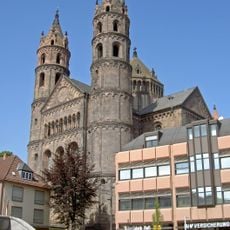
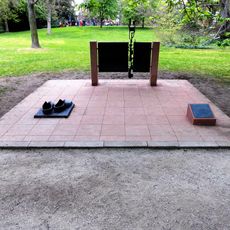
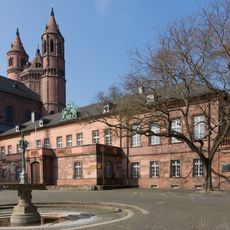
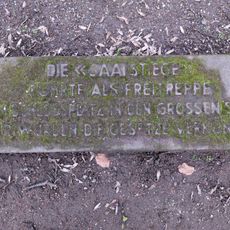
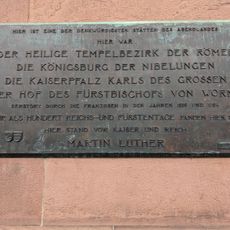
The church no longer exists: it was demolished before 1812, and its site south of Worms Cathedral is now a lawn with trees forming the cathedral's southern forecourt. About 90 spolia from the building are kept in the Museum der Stadt Worms, with further fragments in Frankfurt, Heidelberg, Mainz and Nuremberg. Excavation is proposed before the square is redesigned.
The church was demolished before 1812; its stones were sold as building material by master mason Philipp Jakob Blattner and carpenter Bertrand, who bought it at auction on 26 January 1807 for 4,958 francs. About 90 spolia are kept in the Museum der Stadt Worms, with further fragments in Frankfurt, Heidelberg, Mainz and Nuremberg.
The community of curious travelers
AroundUs brings together thousands of curated places, local tips, and hidden gems, enriched daily by 93,811 contributors worldwide.