Siegfriedbrunnen, Medieval fountain in central Worms, Germany.
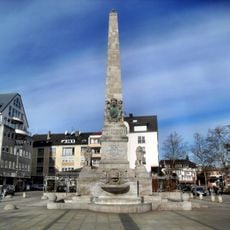
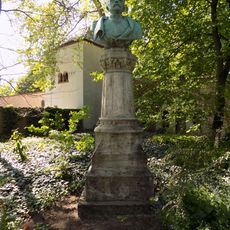
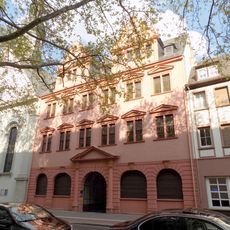
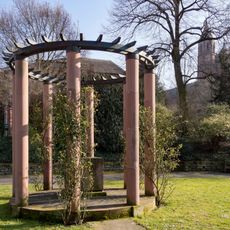
The Siegfriedbrunnen is a seven-sided domed structure of shell limestone standing at the Marktplatz, at the mouth of the Hagenstraße and directly in front of the Haus zur Münze. On its highest point stands Siegfried the dragon-slayer with his sword. The fountain, which contains elements modelled on Romanesque art, is a protected cultural monument.
In 1895 the Worms industrialist Cornelius Wilhelm Heyl proposed a Nibelungen fountain south of the Trinity Church; city architect Karl Hofmann's design was rejected by the council. The present Muschelkalk fountain was made in 1913 by Munich sculptor Adolf von Hildebrand, funded by Heyl and his wife Sophie. Because of the First World War it was only set up in 1921, in front of the Cornelianum, which was later demolished and replaced by the Haus zur Münze.
The fountain takes its name from Siegfried, the dragon-slayer of the Nibelung legend, and its top figure shows him with his sword. A related monument to Hagen von Tronje, the Hagendenkmal, was made a few years earlier and now stands on the Worms bank of the Rhine.
The fountain sits in the center of Worms on the Rathausplatz and is easily accessible on foot. It serves as a convenient meeting point and a good starting place for exploring the surrounding old town.
The fountain was funded by the Worms industrialist Cornelius Wilhelm Heyl and his wife Sophie, who donated the money for the Muschelkalk structure. Completed in 1913, it could only be set up in 1921 because of the turmoil of the First World War.
The community of curious travelers
AroundUs brings together thousands of curated places, local tips, and hidden gems, enriched daily by 94,649 contributors worldwide.