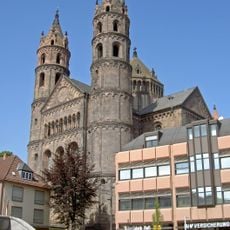
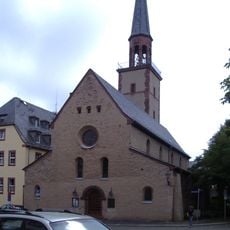
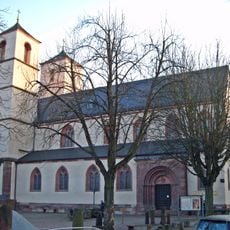
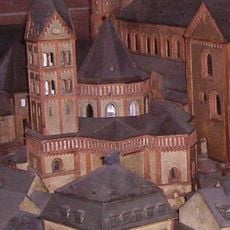
Andreasstift, Romanesque church in Worms, Germany
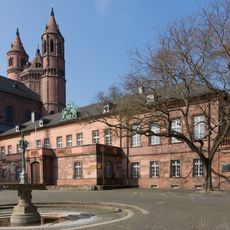
Andreasstift is a former collegiate church complex in Worms, centred on the Andreaskirche, a three-aisled Romanesque basilica built from 1130/40 with a straight choir between two square east towers. Its north portal resembles the west choir of Worms Cathedral, dating that section to around 1200. Two wings of the Romanesque cloister survive and now serve as a lapidarium.
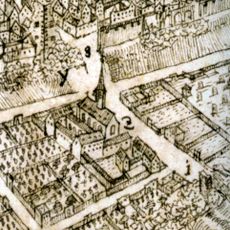
The collegiate foundation of St. Andreas is first documented in 1016. Around 1020 Bishop Burchard moved it inside Worms' city walls to its present site, where a church already stood. The present Andreaskirche was built from 1130/40 as a three-aisled Romanesque basilica; after a fire in 1200 it received Gothic windows. In 1499 the canons moved to Ladenburg for ten years during a dispute with the city.
The dedication to the Apostle Andrew placed the foundation among Worms' five collegiate churches, alongside the cathedral and St Cyriakus, St Paul and St Martin. Its provost was one of the four provosts of the Diocese of Worms. The parish church of St Magnus, near the complex, belonged to the foundation before the Reformation.
The museum occupies the former Andreaskirche and two surviving wings of the Romanesque cloister, which now serve as a lapidarium. The complex stands at Weckerlingplatz, the onetime cemetery of the foundation, a short walk from Worms Cathedral and the Magnuskirche. The building was restored in 2007.
The museum moved into the Andreasstift on 1 July 1930, when a procession from the Paulusstift marked the end of the French occupation that had begun in November 1918. The restoration of 1928 to 1930 was paid for by a legacy of 200,000 gold marks from Baron Maximilian von Heyl, younger brother of the Worms industrialist Cornelius Wilhelm von Heyl.
The community of curious travelers
AroundUs brings together thousands of curated places, local tips, and hidden gems, enriched daily by 93,799 contributors worldwide.