Bavariapark, Park and architectural heritage monument in Schwanthalerhöhe, Munich, Germany.
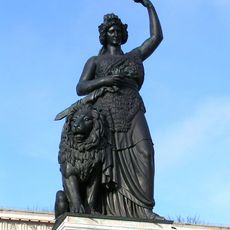
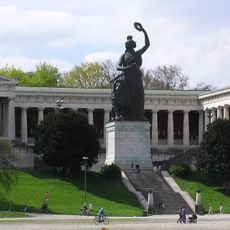
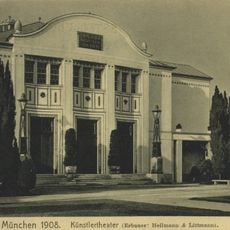
Bavariapark covers 6.8 hectares behind the Bavaria statue and the Ruhmeshalle on the Theresienwiese. Its open meadow and the König-Ludwigs-Hügel survive from the original oak-planted layout, while the Bavariaring road cuts through the grounds. Since the 1908 exhibition the park has held sculptures such as Heinrich Düll and Georg Pezold's "Liegende Quellennymphe" and Fritz Behn's "Kraft", a Hercules on a bull.
King Ludwig I had the park planted with oaks between 1825 and 1831 by court gardener Seitz, first under the name Theresienhain, as the setting for Leo von Klenze's Ruhmeshalle. When the Bavaria statue was inaugurated in 1850, the park took its present name. It only opened to the public in 1872, with walking paths and the König-Ludwigs-Hügel.
The park takes its name from the colossal Bavaria statue that dominates the site and gives it character. Visitors experience a place deeply woven into Munich's identity, regularly used by locals for daily recreation.
The park is accessible year-round and sits within walking distance of public transit connections. Visitors should note that a major road divides the area into two sections, affecting how you move through the space.
The area still bears the marks of transformation from the early 1900s when it was redesigned following English garden principles. Stone sculptures from that redesign period remain visible today, telling of the aesthetic ideas that shaped the space.
The community of curious travelers
AroundUs brings together thousands of curated places, local tips, and hidden gems, enriched daily by 93,875 contributors worldwide.