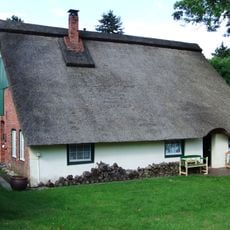
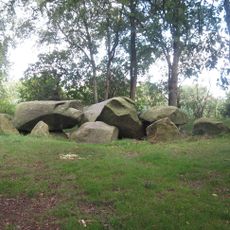
Feddersen Wierde, Archaeological site near Wremen, Lower Saxony, Germany
Feddersen Wierde is an excavated settlement mound, or Wurt, near the Weser estuary between Wremen and Mulsum. At its height in the 3rd century it covered about 4 hectares and held 26 longhouses arranged in a semicircle around an open square. The houses were three-aisled, roughly 20 m long and 5 m wide, with oak posts and wattle-and-daub walls.
Feddersen Wierde was settled from the 1st century BC by Old Saxons, who first built flat farmsteads on a storm ridge. From the later 1st century AD they raised ring-shaped mounds of dung and clay, about 1 m high, for each new house. By the 3rd century these had merged into a village mound about 4 m high and 4 ha in area, with 26 longhouses and some 300 inhabitants. The site was abandoned in the 5th century, probably as people migrated to England.
Feddersen Wierde was inhabited by Old Saxons, and the Chauci before them, who according to Pliny hunted fish left behind by the tide from their huts. Excavations found bronze and iron workshops, a threshing floor and a large three-aisled building without inner partitions, possibly used for assemblies and banquets. Roman coins, bronzes and vessels show that part of the produce reached long-distance trade.
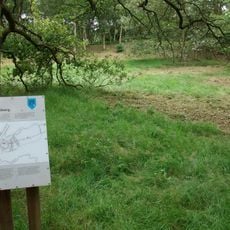
The site is open to visitors with information panels explaining the settlement layout and excavation findings. It helps to understand beforehand that the site is an open field with markers rather than a covered museum space.
The excavation between 1954 and 1963 was led by Werner Haarnagel of the Lower Saxony institute for marsh and terp research in Wilhelmshaven. Over eight settlement phases the site produced about 175 dwellings and 144 granaries. The finds are displayed at Burg Bederkesa in Bad Bederkesa.
The community of curious travelers
AroundUs brings together thousands of curated places, local tips, and hidden gems, enriched daily by 92,836 contributors worldwide.