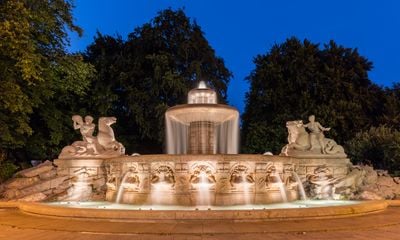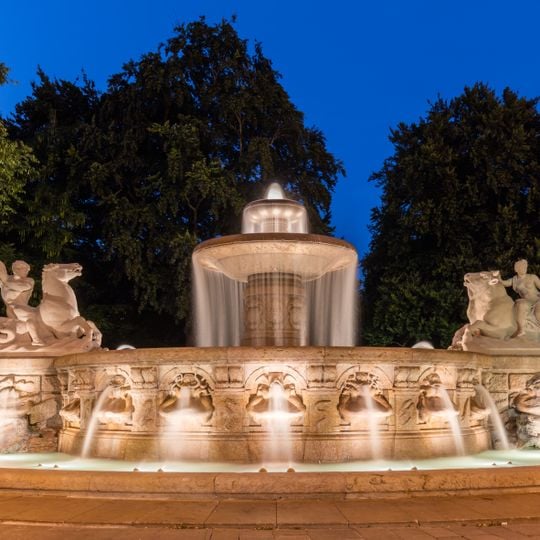
Wittelsbacherbrunnen, Neoclassical fountain at Lenbachplatz, Munich, Germany.
The Wittelsbacherbrunnen is a neoclassical fountain at Lenbachplatz in Munich, built from Untersberg marble and limestone. It features a large semicircular basin flanked on each side by a monumental sculptural group placed on a raised stone base.
The fountain was created by sculptor Adolf von Hildebrand between 1893 and 1895 to mark the completion of Munich's water supply system from the Mangfall Valley. It takes its name from the Wittelsbach dynasty, the ruling family of Bavaria for several centuries.
The two flanking groups are carved from Untersberg marble. On the left a youth rides a fish-tailed water horse and raises a boulder to throw, an allegory of water's destructive force in the mountain streams of the Mangfall Valley. On the right an Amazon on a fish-tailed water bull holds out a bowl of water, standing for water's life-giving power once channeled to the city.
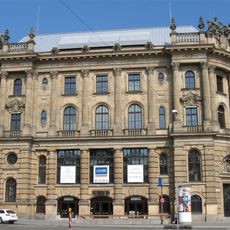
The fountain stands at Lenbachplatz, on the edge between central Munich and Maxvorstadt, within easy walking distance of the city center. Because it sits at a busy road junction, it helps to walk around the full perimeter to see both sculptural groups clearly.
The fountain was the first of five monumental city fountains Adolf von Hildebrand created in Munich. The commission was conditional on his moving his residence to the city, and he worked on it for nearly two years with the sculptor Erwin Kurz before its unveiling on 12 June 1895.
The community of curious travelers
AroundUs brings together thousands of curated places, local tips, and hidden gems, enriched daily by 94,638 contributors worldwide.