Steinerne Rose, Natural monument in Kloster, Germany
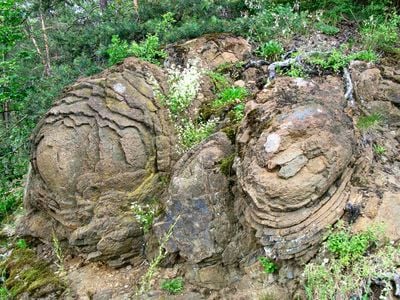
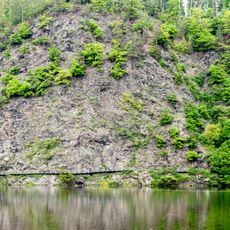
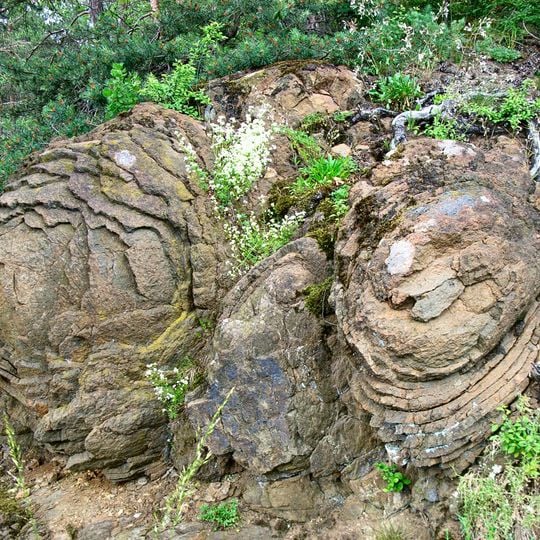
The Steinerne Rose is a diabase rock formation near Kloster where natural weathering has created concentric shells that resemble the petals of an opening rose blossom. These geometric patterns develop as the hard stone gradually sheds its outer layers over time.
The rock formed from lava eruptions during the Middle Devonian period roughly 400 million years ago, when this area lay beneath ancient seas. These volcanic processes continue to shape how geologists understand Thuringia's geological landscape today.
The name comes from the weathered lava pillows, whose concentric shells make them look like opening rosebuds. In a 2013 Heinz Sielmann Stiftung and EUROPARC Deutschland poll of 21 German natural monuments, the Steinerne Rose was voted Germany's second most beautiful natural wonder, behind the Rauhe Kulm near Neustadt am Kulm. Smaller stone roses also "bloom" on the Schlossfelsen rocks in Ronneburg.
The formation sits about 700 meters north of Kloster village along road L 1095, just before the bridge over the former railway line. It is easy to reach and visible from the road, making a quick stop convenient during travel through the area.
In a 2013 poll by the Heinz Sielmann Foundation and EUROPARC Deutschland, this formation was voted Germany's second most beautiful natural wonder of the year, chosen from 21 candidates; the Rauhe Kulm near Neustadt am Kulm took first place and the Stiefel near St. Ingbert third.
The community of curious travelers
AroundUs brings together thousands of curated places, local tips, and hidden gems, enriched daily by 94,457 contributors worldwide.