Metten Abbey, Benedictine abbey in Metten, Bavaria, Germany
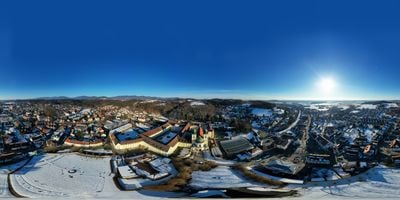
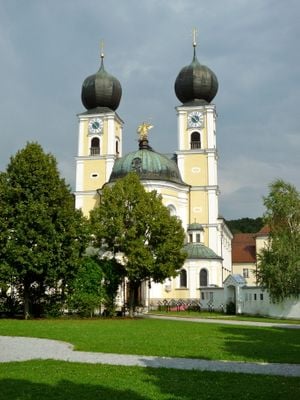
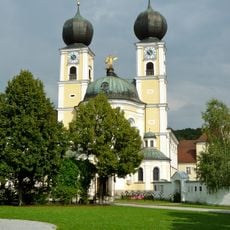
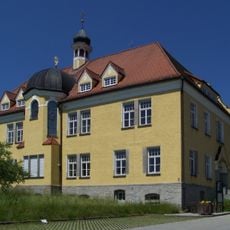
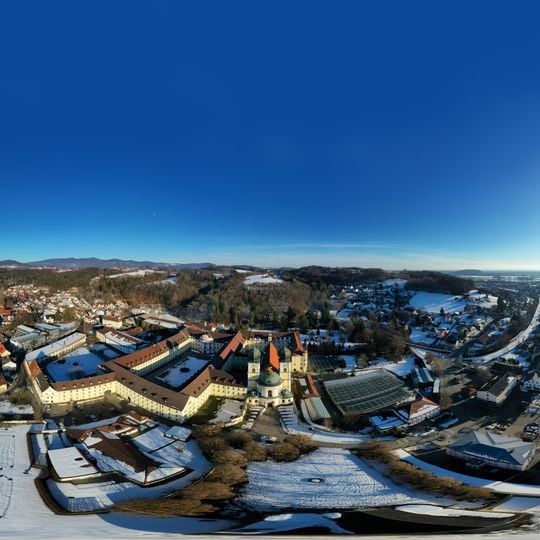
Metten Abbey is a Benedictine monastery of pale yellow walls and red tiled roofs arranged around snow-covered courtyards on a sloping site between the Danube valley and the Bavarian Forest. Its church, dedicated to St. Michael, has a tall facade with two green-domed towers and a large green copper dome crowned by a golden figure. The abbey runs St.-Michaels-Gymnasium and craft workshops, and its Baroque library, built 1722–1726, holds over 150,000 volumes.
Founded in 766 by Gamelbert of Michaelsbuch, the abbey underwent a crucial shift when Charlemagne took control in 788. This transition marked the beginning of the monastery's role within the broader structure of Carolingian authority in the region.
The abbey's library, built between 1722 and 1726 under Abbot Roman II Märkl, holds over 150,000 volumes on theology, philosophy and history. Among them is a 1434 illuminated Gregorian chant manuscript written by hand on sheepskin parchment. The library is open for tours, and a 1415 manuscript found there helped decode the abbreviations of the Vade retro satana formula on Saint Benedict Medals.
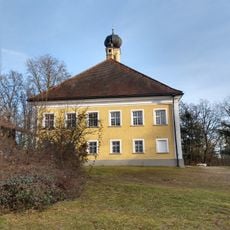
The site currently functions partly as a boarding school (St.-Michaels-Gymnasium), which means certain areas may be restricted during school hours or activities. Visitors should confirm access times beforehand to ensure they can explore the areas of interest without disrupting the educational programs.
A manuscript found in the library in 1415 revealed the meaning of symbols used on Saint Benedict Medals, solving a long-standing question for scholars. This discovery provided important evidence for understanding religious objects that believers carried with them.
The community of curious travelers
AroundUs brings together thousands of curated places, local tips, and hidden gems, enriched daily by 93,998 contributors worldwide.