Hohle Fels, Archaeological cave site in Schelklingen, Germany
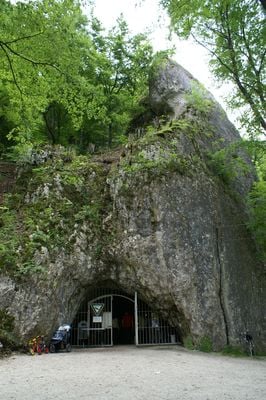
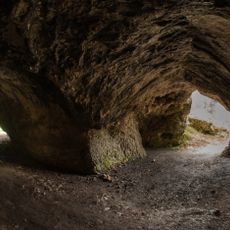
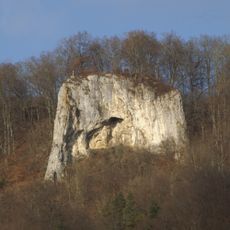
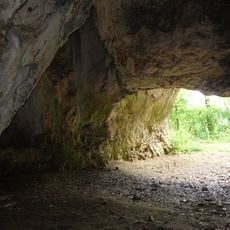
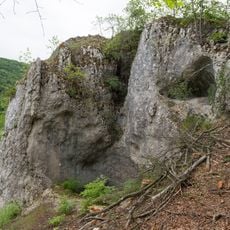
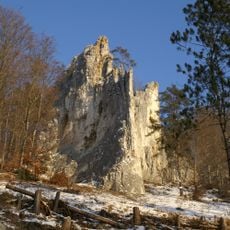
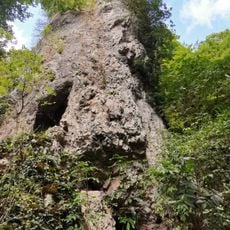
Hohle Fels is a cave about 1 km east of Schelklingen's town centre, with a 30 m long passage leading to a hall up to 30 m high and 500 m² in area, from which two side passages branch off. Its entrance, at 534 m above sea level, is set in a sponge-stone outcrop of the White Jura on the right slope of the Ach valley. The cave's shape gives it the name Backofenhöhle, or oven cave.
The first excavation took place in 1870, when Oscar Fraas and Josef Hartmann recovered bones of cave bear, reindeer, mammoth and wild horse. In 1872 Rudolf Virchow visited the cave, which had been fitted with a gate and wooden walkways for the occasion. From 1977 the University of Tübingen excavated under Joachim Hahn, and Nicholas Conard has directed the annual digs since 1997; by 2016 over 80,000 stone artefacts had been recovered. The cave joined the UNESCO World Heritage list in 2017.
The cave's name means "hollow rock" in German, and potter Karl Friedrich Rixinger was digging for clay there in 1830 when he struck cave-bear bones. Excavations since 1997 under Nicholas Conard of the University of Tübingen have recovered more than 80,000 stone artefacts and almost 300 pieces of jewellery, including the 6 cm Venus of Hohlefels carved from mammoth ivory.
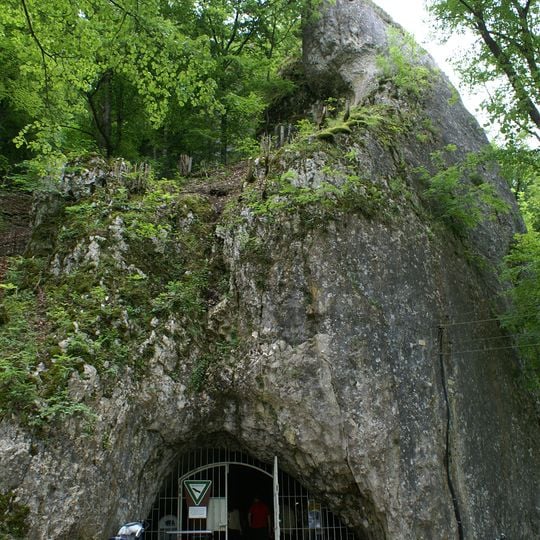
The cave lies about one kilometre east of Schelklingen's town centre, at the foot of the right slope of the Ach valley; the entrance sits at 534 m above sea level and is closed by a barred metal gate. The 30 m entrance passage leads into a hall up to 30 m high with 500 m² of floor, from which two side passages of just over 20 m branch off.
Bone flutes were found in the cave, among the oldest known musical instruments. A small ivory female figure discovered here also ranks among humanity's earliest artworks.
The community of curious travelers
AroundUs brings together thousands of curated places, local tips, and hidden gems, enriched daily by 92,982 contributors worldwide.