Geißenklösterle, Archaeological rock shelter in Ach Valley, Germany
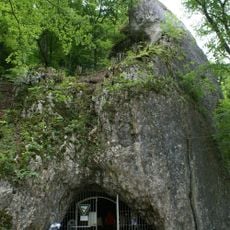
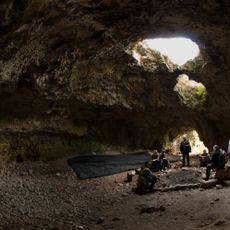
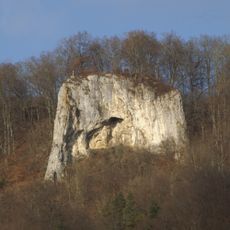
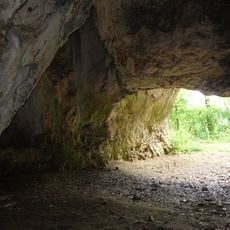
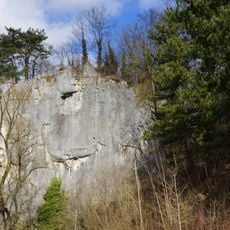
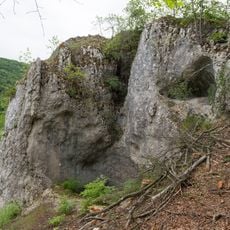
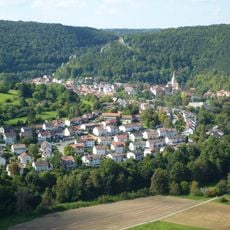
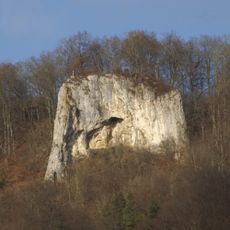
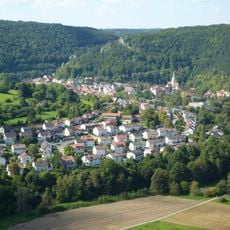
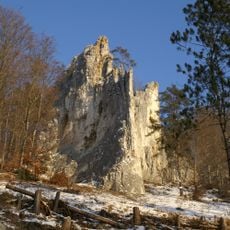
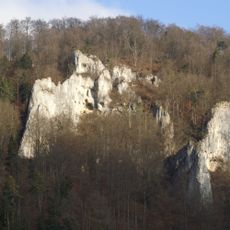
Geißenklösterle is a half-cave or abri in the Ach Valley south of Weiler, a district of Blaubeuren, about 60 metres above the valley floor. Its entrance is sheltered by two projecting rock walls. The cave contains sediments divided into six Aurignacian and seven Gravettian levels, with Middle Palaeolithic layers below and later deposits up to the Middle Ages.
Excavations from 1973 to 2002 revealed that humans inhabited this shelter starting around 43,000 years ago, with successive Stone Age cultures using the location over millennia. The findings established this rock shelter as a key record of life during that distant period.
The site yielded two flutes from the Upper Aurignacian layer: a 12.6 cm swan-bone flute found in 1990 and a fragmentary bird-bone flute, both with carefully cut notches and flat finger holes. The ivory Adorant, a half-relief of a figure with raised arms, may show a ritual gesture.
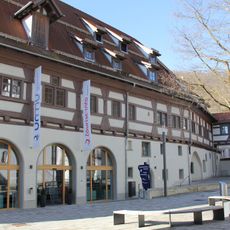
A zigzag path leads up to the rock shelter and makes the site accessible to visitors. Guided tours can be arranged by contacting the Prehistoric Museum in nearby Blaubeuren.
The UNESCO listing covers six caves in two valleys; Geißenklösterle is one of three in the Achtal, alongside Hohle Fels and Sirgenstein Cave. The other three, including Vogelherd and Hohlenstein-Stadel, lie in the Lonetal. Germany applied for the listing in January 2016 and the committee awarded it in July 2017.
The community of curious travelers
AroundUs brings together thousands of curated places, local tips, and hidden gems, enriched daily by 94,050 contributors worldwide.