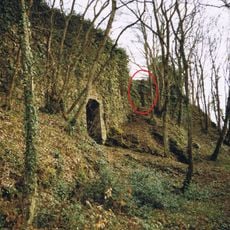
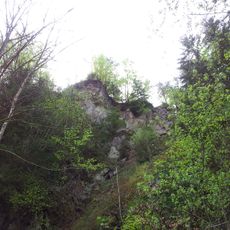
Iburg, castle ruin
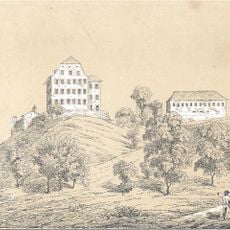
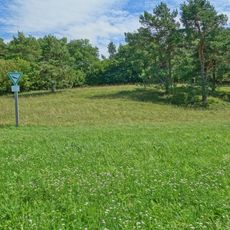
Iburg is a ruined spur castle on a 520-metre rock spur above the Albtal, about 500 metres west of Steinbach. It had a bergfried with an attached round structure measuring 7 by 12 metres with 1.3-metre-thick walls; only wall remnants of this round structure survive. Metz suggests it was a cistern for a roof well attached to a residential tower, and that the site had an outer and a main castle.
Iburg was probably built in the 10th or 11th century; a path once linked it to the nearby settlement of Steinbach, which led Ebner (1950) to suggest it was the seat of the lords of Steinbach, documented as Johann von Steinbach in 1341 and 1350, Turingus in 1380 and another Johann in 1492. The lords of Urberg may also have built it. After Tiefenstein Castle was destroyed in 1272 and that family lost power, the Iburg was probably abandoned. Much of its stone was removed between 1854 and 1863 for the Albtal road, destroying the northern part of the hill.
The name Iburg probably derives from "Eibe" (yew), though a link to "Fliehburg" (refuge castle) is also considered. The site is associated with the lords of Steinbach, documented as Johann von Steinbach in 1341 and 1350, Turingus in 1380 and another Johann in 1492; the lords of Urberg may also have built it. The ruin is not a Schloss.
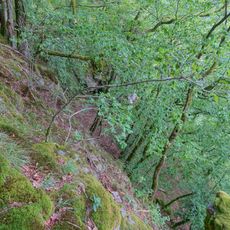
The site lies roughly one kilometer from the main valley road and is accessible on foot from a place called Tiefenstein. Be aware that the terrain is quite steep in places and some areas can be hazardous, particularly when wet.
Near the ruins stands an ancient wall called the Landhag that may date to Roman times, running from the Wehra river toward the village of Wieladingen. Scholars continue to investigate whether this wall is of Roman or early Germanic origin.
The community of curious travelers
AroundUs brings together thousands of curated places, local tips, and hidden gems, enriched daily by 92,682 contributors worldwide.