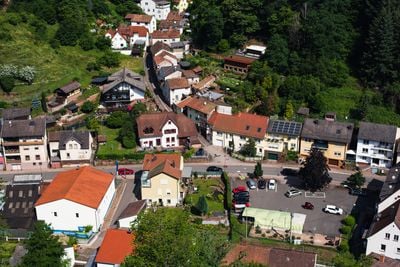
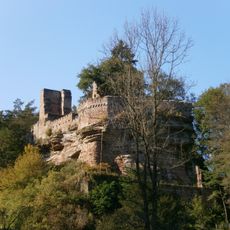
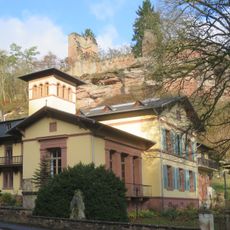
Frankenstein Castle, Medieval castle ruins in Frankenstein, Germany
Frankenstein Castle is a ruined spur castle above the village of Frankenstein in the Palatinate Forest, Rhineland-Palatinate. Its lower bailey is dominated by the three-part palas of the 13th century, built in late Staufer and early Gothic style, with lancet windows and a surviving multi-storey chimney stack in its central section. A rock stair leads up to the remains of the upper bailey, chiefly the 12th-century watchtower.
The name Frankenstein first appears in a 1146 document naming the free nobleman Helenger of Frankenstein, though a defensive tower is reported around 1100. Limburg Abbey, which held the tower, tasked the counts of Leiningen with its protection in 1205, and they expanded it into a castle in the early 13th century. From 1204 to 1231 the knights Marquard, Friedrich and Helenger von Frankenstein served as administrators. Around 1390 it became a joint heritage castle, and after 1560 it was considered uninhabitable.
The castle's name comes from the free noble family of Frankenstein, first recorded in 1146 with Helenger von Frankenstein. From 1204 to 1231 the knights Marquard, Friedrich and Helenger von Frankenstein are named in charters as administrators and castle men of the counts of Leiningen. The site is a protected monument and can be visited at any time free of charge.
The grounds are open year-round with walking paths leading through the ruins and marked routes for visitors. Parking and outdoor seating areas are available for those who want to rest while enjoying the surroundings.
The castle's oldest known depiction is a cartouche printed on leaflets reporting its capture by the Spanish general Ambrosio Spinola in the Thirty Years' War, probably in September or October 1620; the same woodcut was reused twenty times. The buildings were likely handed over without a fight before later damage.
The community of curious travelers
AroundUs brings together thousands of curated places, local tips, and hidden gems, enriched daily by 92,659 contributors worldwide.