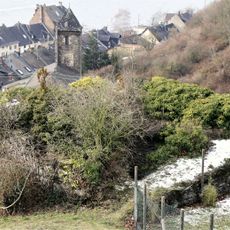
Fürstenberg Castle, Medieval castle in Oberdiebach, Germany.
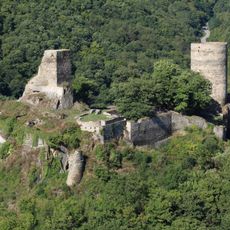
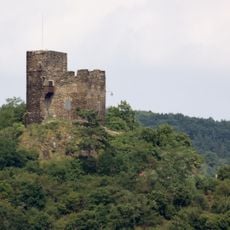
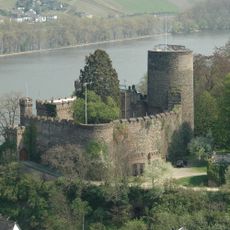
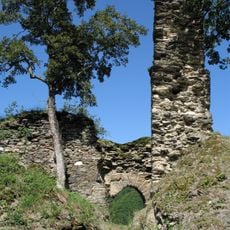
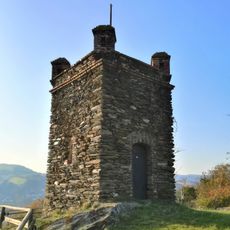
Fürstenberg is a ruined hilltop castle above Rheindiebach, built of slate rubble masonry partly on bedrock. Its 26-metre keep, 10 metres across at the base with 4-metre-thick walls, was originally entered only through a door 12 metres up. The three-storey palas survives to the second floor, and a three-quarter tower was added around 1500 to flank the western shield wall with firearms.
Archbishop Engelbert I of Cologne had Fürstenberg built in 1219 to secure the Electorate of Cologne's holdings between Manubach and Bacharach and to enforce tolls, together with a watchtower on the Rhine bank. It passed as a hereditary fief to the Electors Palatine in 1243, who bought it outright in 1410. Around 1500 a three-quarter round tower was added to the ring wall for flanking fire with firearms. French troops destroyed the castle in 1689 during the War of the Palatine Succession, and unlike most castles of the Upper Middle Rhine Valley it was never rebuilt in the 19th century.
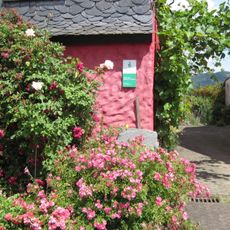
The name Fürstenberg refers to the archbishops of Cologne, who built the castle in 1219; the site later passed to the Electors Palatine. Visitors can still see large areas of original plaster from every building phase, beginning in the 13th century, whose first coat was a broken white made with coarse mortar 0.5 to 2.5 cm thick.
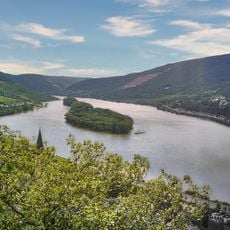
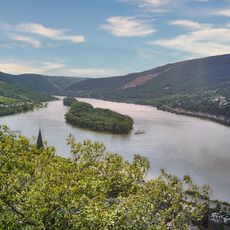
The site is privately owned and closed to public access, but the Rhine valley provides several viewpoints from riverside paths and roads. Photography is possible from the road toward Rheindiebach or from river cruises passing through the area.
The castle's original plaster survives across large areas, from the 13th century onward, letting conservators trace its colour scheme; the first render was a broken white, 0.5 to 2.5 cm thick with particles up to 20 mm. Such plaster is rare in the Rhine valley.
The community of curious travelers
AroundUs brings together thousands of curated places, local tips, and hidden gems, enriched daily by 94,085 contributors worldwide.