Castle Linn, Medieval castle in Krefeld, Germany.
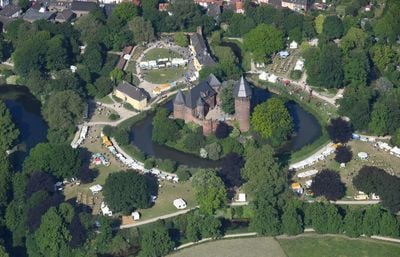
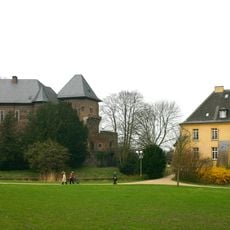
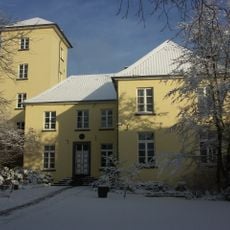
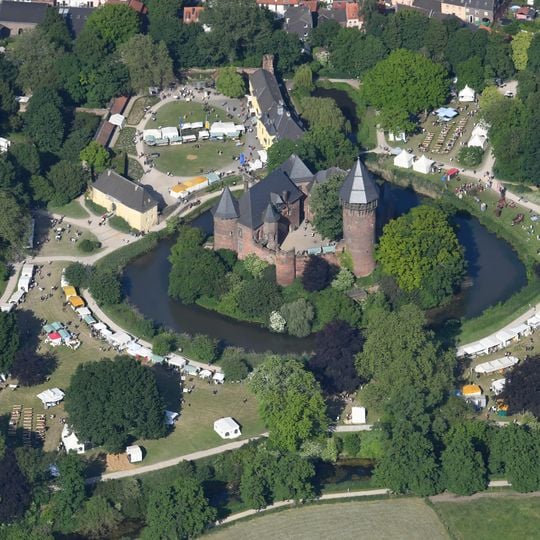
Castle Linn is a water castle on an island in Krefeld-Linn, about five kilometres east of Krefeld's centre. Its ring wall of dark red brick, begun in 1195, encloses a steep grey roof with pointed turrets, and a tall cylindrical brick tower with a dark conical roof stands to the right. A lower wing with a pale yellow facade extends to the left.
Around 1000 a motte with a wooden watchtower stood on the site. In 1188 Otto von Linn sold the allodium to the Archbishop of Cologne but kept the castle as a fief, and after the Third Crusade he rebuilt it in brick; the ring wall was completed in six sections between 1195 and 1250. In 1702 French troops were driven out and the castle burned, and after 1728 it stood uninhabitable, with the keep used as a prison.
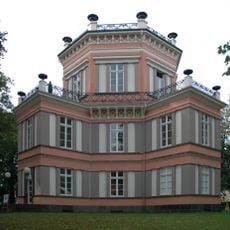
The castle museum displays finds from excavations in the Rhineland, and the adjoining hunting lodge has rooms furnished in 18th- and 19th-century style, a fully equipped Lower Rhenish farm kitchen and a collection of old musical instruments. At Pentecost the flax market is held by the castle, a re-enacted medieval market with games, costumes and music.
The castle is accessible on foot or by public transport and features onsite information and signage to help visitors navigate the various areas. Comfortable footwear is recommended since the grounds are uneven and several buildings are connected by pathways with steps.
The keep, called the Butterturm, takes its name from the Büttel, the bailiff whose prisoners were held there after 1728, when the burnt-out castle was declared uninhabitable. From its top visitors look over the park and the Krefeld districts of Linn and Uerdingen. The roof visible today dates from restoration work in the 1980s, funded by donations; no documents survive for the original roof, so the steep pitch is a compromise.
The community of curious travelers
AroundUs brings together thousands of curated places, local tips, and hidden gems, enriched daily by 92,639 contributors worldwide.