Burgruine Birkenstein, Castle ruin in Leinefelde-Worbis, Germany.
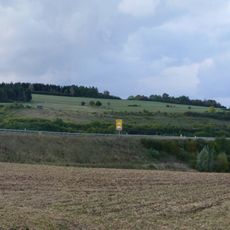
Burgruine Birkenstein is the site of two medieval castle ruins on the western flank of the Wingert ridge, about one kilometre south of Birkungen. Birkenstein I measures 70 by 50 metres with rounded corners; a 19th-century quarry removed most above-ground walls. Birkenstein II, 300 metres northeast, is a 19 by 17 metre earthwork with a 3-metre-wide moat.
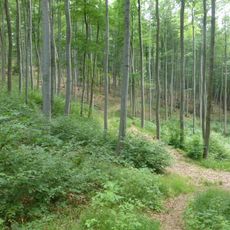
Birkenstein was first documented in 1256, when Ernst von Birkenstein donated it to Reifenstein Monastery. In the 13th century it passed to the Counts of Gleichenstein, who leased it to Mainz in 1287 and sold it in 1294 to Elector Gerhard II of Eppstein, tying the Eichsfeld to Mainz until 1802. The castle was reportedly still in good condition in 1323, but was later abandoned; today only the moat and a wall overgrown with tall forest are visible.
The name Birkenstein comes from the noble family of the same name, first recorded with Reinher von Birkenstein in 1206. A local legend tells of the Kellerjungfrau: a maiden hid in the castle cellar during an attack, survived a storm, and was said to be seen later with a birch broom. The story still shapes local tradition in Birkungen.
The ruins are reached via marked walking paths from Leinefelde-Worbis and are freely accessible throughout the year. The walk to the elevated location is straightforward and the site can be visited in any season.
The legend of the Kellerjungfrau, the cellar maiden, is still told in Birkungen: when the castle was stormed, she hid in the cellar, survived the storm and searched the village with a birch broom for the knight, who had fallen at Frankenhausen. Locals say she was never reported dead and later generations claimed to have seen her.
The community of curious travelers
AroundUs brings together thousands of curated places, local tips, and hidden gems, enriched daily by 92,651 contributors worldwide.