Haselstein Castle, Castle ruin in Nüsttal, Germany
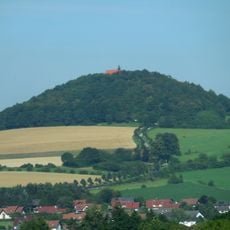
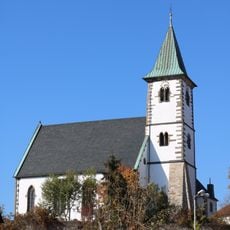
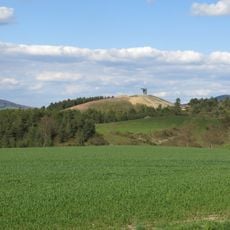
Haselstein Castle is a ruined hilltop fortification on a phonolite cone at about 465 m above sea level, next to the village of Haselstein in Nüsttal, Hesse. Only low sections of the perimeter wall and two sides of the gate tower, measuring 9 by 11 metres, remain; the round bergfried, about six metres across, has vanished. Wall traces east of the main wall suggest an outer bailey or zwinger above the church and the later castle.
The rock was recorded in 780/781 as Haselahastein. The hilltop castle, probably built in the 11th century by the lords of Haselstein, was first mentioned in 1113, when Abbot Wolfhelm of Fulda failed to take it; Abbot Erlof of Bergholz conquered it in 1119 to end the robber baronetcy based there. From the late 13th century to about 1605 it was the seat of the Fulda office of Haselstein. Last mentioned in 1512, it was abandoned after a new office building, Schloss Haselstein, was built at the foot of the hill in 1546.
The remaining walls and gateway tower sections show how medieval fortifications were built and used to control the surrounding valleys. These physical traces help visitors understand the role such strongholds played in organizing life across the region centuries ago.
Hiking trails lead up to the ruins, providing views across the valley as you climb the steep basalt hill. Wear sturdy footwear and plan for an active walk, as the terrain is uneven and the grade is steep.
The castle was last documented in 1512, when Dietrich von Ebersberg served there as Amtmann. From 1546 the unused hilltop site was quarried for stone after a new Amtshaus, Schloss Haselstein, was built at the foot of the hill.
The community of curious travelers
AroundUs brings together thousands of curated places, local tips, and hidden gems, enriched daily by 93,807 contributors worldwide.