Tannenfels Castle, Medieval castle ruins in Dannenfels, Germany
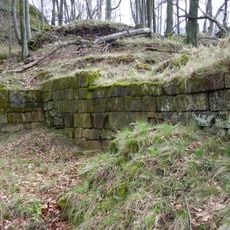
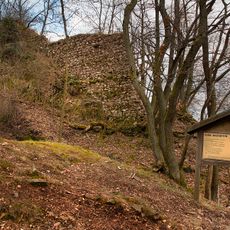
Tannenfels is a castle ruin in Dannenfels featuring preserved wall sections, a standing tower, and the remains of supporting structures at an elevation of approximately 460 meters. The site displays typical medieval fortification elements including ring walls, a historic well, and foundation stones of former buildings.
Tannenfels is first documented in 1330, when Count Philip of Sponheim-Bolanden-Dannenfels and his wife Lisa of Katzenelnbogen endowed a chapel in the castle. Around 1368 Henry II moved his seat to Kirchheimbolanden; after his death in 1393 the castle passed to Nassau-Saarbrücken, and in 1431 part went to the counts palatine. In 1525 rebellious peasants destroyed it and it was later demolished; the ruins stayed with Nassau-Saarbrücken until 1797.
The castle chapel was dedicated to St. Mary; on 20 December 1354 Archbishop Gerlach of Mainz confirmed a benefice endowed by Philip of Sponheim-Bolanden. In 1449 the Mainz vicar general Siegfried Piscator entrusted its pastoral care to the nearby Abbey of St. James. A 1657 description notes the village had no church, the former one having stood at the castle and been ruined years before.
The ruin sits at 460 m above sea level on a man-made bank and motte system above Dannenfels on the Donnersberg. Paths lead up from the village; the ground is uneven and only remnants of a tower, a supporting wall and the castle well remain. Sturdy shoes help, and the well and wall stumps are easy to miss among the vegetation.
The castle chapel, dedicated to St. Mary, was endowed in 1330 by Count Philip of Sponheim-Bolanden-Dannenfels and his wife Lisa of Katzenelnbogen. A 1657 description notes that Dannenfels had no church, as the former one above the castle had been ruined years before.
The community of curious travelers
AroundUs brings together thousands of curated places, local tips, and hidden gems, enriched daily by 94,348 contributors worldwide.