Eremitenklause Börrstadt, Cave church and hermitage in Börrstadt, Germany
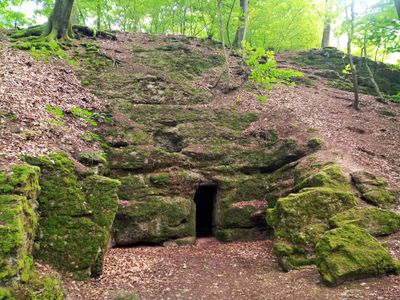
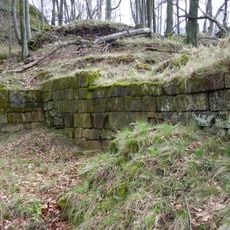
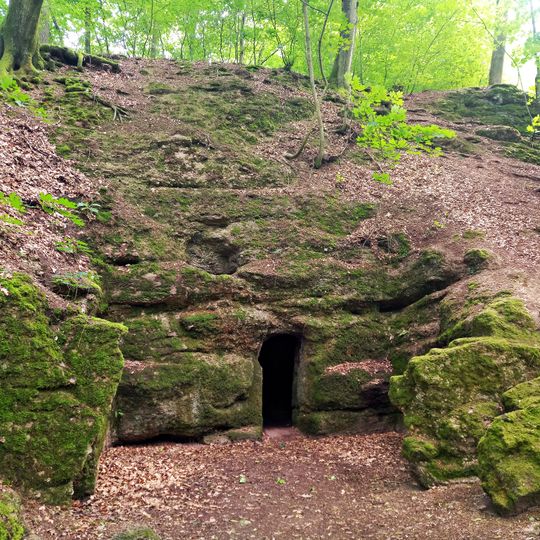
The Eremitenklause is a rock-cut chapel with the remains of a hermit's dwelling at the foot of the Donnersberg, about one kilometre northwest of Hahnweilerhof. A roofless rectangular antechamber, roughly four by three metres, precedes the chapel; its south wall holds the 1.80-metre entrance. The chapel chamber measures about 2.5 by 4 metres and 3 metres high, with a medieval ribbed vault cut into the rock and a window opening above the entrance.
The hermitage was established around 1468 and the surrounding forest became known as Klausenbusch, reflecting the early religious presence in the area. The site remained a place of retreat and contemplation throughout the following centuries.
The chapel's name lives on in the forest around it, called Klausenbusch by 1468. A local legend tells of two children from Hahnweilerhof who drank at the spring and saw an old man reflected in the water; his staff, planted in the ground, grew into a large white beech. The tale echoes the legend of Saint Gangolf, whose staff likewise struck a spring.
The hermitage lies about one kilometre northwest of Hahnweilerhof, in the south slope of a small valley; the approach is on foot from the valley's north side. The spring beside the chapel rises at the site and flows east; since 1911 most of its water has been piped to Hahnweilerhof as drinking water, leaving only a small flow in the stone basin.
The site blends a natural cave formation with hand-carved architectural details, showing how craftspeople worked with the existing rock. The doorway was carved to a height of roughly 1.80 meters, suggesting careful planning to fit human proportions.
The community of curious travelers
AroundUs brings together thousands of curated places, local tips, and hidden gems, enriched daily by 94,515 contributors worldwide.