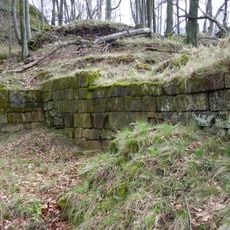
Falkenstein Castle, Medieval castle in Falkenstein, Germany.
Falkenstein Castle is a ruined hill castle on a steep rocky outcrop above the village of Falkenstein on the Donnersberg. Its grey and brown walls stand roofless, with rectangular window openings in the surviving sections. To the left, slightly lower, a separate round tower with a dark conical roof remains. The bergfried itself has almost entirely disappeared, though it once reached 37 metres including its rock base.
Falkenstein is first recorded in 1135 with the lords of Falkenstein, a branch of the Bolanden family. In 1233 Philip I of Falkenstein, Imperial Chamberlain and burgvogt at Trifels, held it. In 1647 French troops stormed and slighted the castle; in 1794 French forces destroyed it again, leaving a ruin partly restored after 1979.
The fortress displays typical features of medieval defense architecture with its thick stone walls and ramparts that still show how fortifications were built centuries ago. Visitors can understand how people once used and protected such strongholds through the layout of its spaces.
The ruin stands on a steep rock above Falkenstein village on the Donnersberg. The bergfried is almost entirely gone, so there is no tower to climb; only a small piece of its wall remains. Parts of the outer walls, shield wall, enceinte and cistern survive, and the site was partially restored from 1979.
The castle's name comes from the lords of Falkenstein, a branch of the Bolanden family first recorded in 1135; the line died out in 1418, after which the county passed to Count Ruprecht IV of Virneburg. Philip I of Falkenstein, named in 1233, was Imperial Chamberlain and burgvogt at Trifels Castle, where the Imperial Regalia were kept.
The community of curious travelers
AroundUs brings together thousands of curated places, local tips, and hidden gems, enriched daily by 92,787 contributors worldwide.