Burtscheider Viadukt, Railway bridge in Aachen, Germany
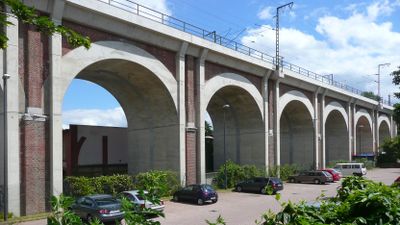
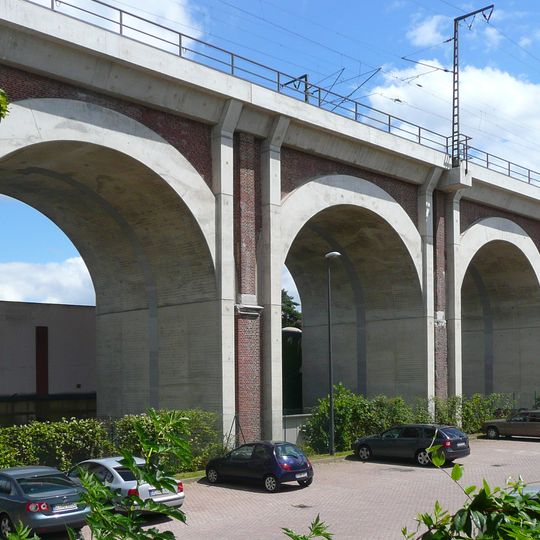
The Burtscheider Viadukt is a brick railway viaduct in Aachen that crosses the Wurmtal valley on the line between Aachen Central Station and Rothe Erde. Built from 1838 to 1840 to plans by engineers A.E. Pickel and F. Wittfeld, it originally measured 277 metres and stood up to 16 metres high. Its eastern end has three arches of 2.7 metres span, followed by eight large arches of 12.2 metres, a central pier with four arches in two rows, and eleven arches of 6 metres.
The viaduct was built between 1838 and 1840 by the Rheinische Eisenbahn company, making it one of the earliest railway viaducts of its kind in Germany. Part of it was damaged in World War II and later rebuilt, though the overall character of the original structure was kept.
The bridge crosses the Wurmtal, formed by the Kalter Bach and Warmer Bach streams. Its western abutment once carried the line over Kurbrunnenstraße, until an SS unit blew up that arch on 16 October 1944; a steel bridge replaced it after the war, shortening the masonry viaduct to 251 metres.
The best way to see the brick arches is from street level below the bridge, where the full height of the construction is visible. The area around the viaduct is easy to reach on foot from the city center and can be visited at any time of year.
At certain points along the structure, the original brick arches sit directly next to metal sections added during postwar repairs, and the difference in material is clearly visible to anyone who looks closely. This makes the wartime history of the bridge readable without needing any explanation.
The community of curious travelers
AroundUs brings together thousands of curated places, local tips, and hidden gems, enriched daily by 92,797 contributors worldwide.