Patrizierhaus, Timber-framed house in Dinkelsbühl, Germany
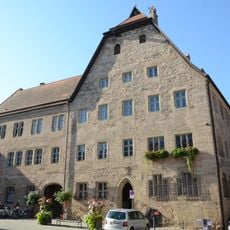
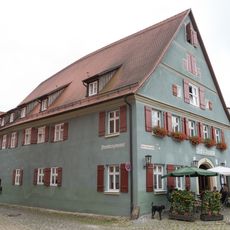
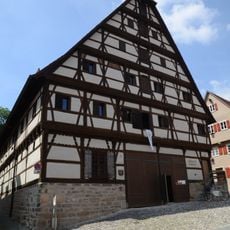
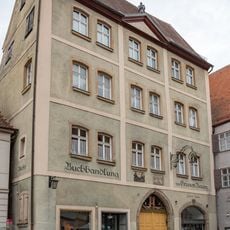
The Deutsches Haus, originally Drechsel Haus, stands on the Weinmarkt between plastered houses. Its sandstone ground floor carries a half-timbered facade of 1593/94, carved with post figures, mask consoles and Atlantes in the storey friezes, all in grey monochrome painting. A Madonna with Child carved around 1700 sits in a first-floor niche, and Bacchus rides a wine barrel in the gable tip.
Built in 1440 as the Drechsel House, it belonged to the councillor and mayor Hans Drechsel, who died in 1540. His son Peter Drechsel I, a mead brewer and innkeeper, rebuilt it in 1543, as a 1765 inscription plaque beside the entrance records. Peter Drechsel II added the late-Renaissance timber facade above the sandstone ground floor in 1593/94. Around 1890 the house, converted into a hotel, was renamed Deutsches Haus.
The facade carries seven planetary gods and a human figure carved beside the windows: Luna, Mercury and Sol on the first upper floor, Saturn, Jupiter, Mars and Venus on the second. They were meant to win the planets' favour for the household. In a niche at the centre stands a wooden Madonna with the Christ Child, carved around 1700.
The house stands on the Weinmarkt, wedged between plastered buildings, so its carved facade is best seen from the square itself. The ground floor is sandstone, with the timber work above. The building now operates as a hotel with a restaurant, so the interior is not freely open to passers-by.
Under the gable's hoisting beam rides a small naked figure on a wine barrel: Bacchus, the wine god, a nod to the house's position on the Weinmarkt and its past as a mead-brewer's inn. The seven planetary gods carved beside the first- and second-floor windows were meant to keep the planets kindly disposed toward the residents.
The community of curious travelers
AroundUs brings together thousands of curated places, local tips, and hidden gems, enriched daily by 92,704 contributors worldwide.