Dolmar, Volcanic summit in Kühndorf, Germany
Dolmar is a 739.6-metre extinct volcano rising about 2 km northwest of Kühndorf, a geological outlier of the Rhön within the Werra-Gäuplatten. Its summit plateau holds traces of Celtic ring walls, the Charlottenhaus mountain inn with a small viewing tower, and a microlight airfield. Basalt was quarried on the mountain until the early 1990s.
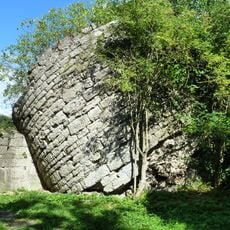
Bronze Age grave finds (2000–100 BC) and visible remains of ring walls, among the largest Celtic earthworks in the former East Germany, point to early use of the summit. In 1668 Duke Moritz of Saxe-Zeitz built a hunting lodge 400 m northwest of the peak; lightning-strike fire destroyed it in 1726. From 1967 the Soviet army used the mountain as a training ground and closed it to the public until its withdrawal in August 1991.
The Dolmar gave its name to Dolmar GmbH, the world's first manufacturer of petrol chainsaws, after Emil Lerp tested the first petrol chainsaw (type A) on the mountain in 1927. Since 1990 the Dolmarfreunde association has maintained the summit and its trails, and the Charlottenhaus inn is named after Charlotte of Prussia, wife of Duke Bernhard III of Saxe-Meiningen.
Several marked trails lead up from the base, and most walkers reach the top in about one to two hours. The Charlottenhaus restaurant near the summit is a good place to stop for food and rest before heading back down.
The Charlottenhaus on the summit is named after Charlotte of Prussia, wife of Duke Bernhard III of Saxe-Meiningen. The Meiningen branch of the Thüringerwald-Verein built it in 1882 on the ruined cellar walls of a ducal hunting lodge erected in 1668 and destroyed by lightning fire in 1726; the poet Rudolf Baumbach dedicated the song "Frisch auf, Kameraden" to its opening on 10 September 1882.
The community of curious travelers
AroundUs brings together thousands of curated places, local tips, and hidden gems, enriched daily by 92,637 contributors worldwide.