Riesenstein, Natural monument in Naumburg, Germany
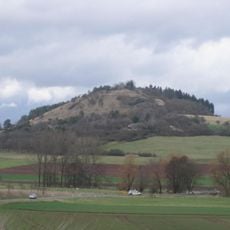
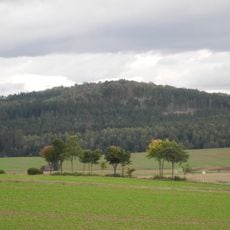
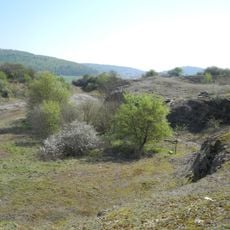
The Riesenstein, also called the Riesenstein von Heimarshausen, is a roughly nine-metre-high sandstone rock in the Heimarshausen district of Naumburg. It is white-red, veined with quartz, and heavily split and fissured by weathering. It stands on the plateau-like summit of the Ziegenrück (318.2 m), a southeastern spur of the Heiligenberg in the Habichtswald nature park.
Archaeological digs in 1998 and 1999 on the rock's plateau brought up stone and bone artefacts, hand axes, pottery and spindle whorls, pointing to repeated use as a resting and camping place from the Mesolithic to modern times. Two ring-wall-like section ramparts, 155 m and 95 m long, lie on the south-eastern slope and have not yet been studied. A wooden bridge stood at the rock in the 19th century; only the slots for its beams remain in the sandstone.
The name refers to the giant Goliath, who threw the stone at Weidelsburg Castle but it slipped from his little finger and missed. He wept bloody tears, sat down on the rock, forgot to eat and drink out of grief, and died; the hollow where he sat is still shown. Local poet Georg Leithäuser wrote a poem about the rock.
The stone is reachable from the paved road by following signs, about 1.1 kilometers north of the village. The site is accessible on foot and you can walk around the stone from most angles.
The hollow in the main rock, with a drain channel, is said to be where the giant Goliath sat after his failed throw at the Weidelsburg; the depression is still pointed out today. Nearby are heavily weathered rock carvings of animals.
The community of curious travelers
AroundUs brings together thousands of curated places, local tips, and hidden gems, enriched daily by 94,020 contributors worldwide.